Monuments and Memorials in Kyoto
A visual guide from the Kyoto travel guide — see all posters in Visual Guides.
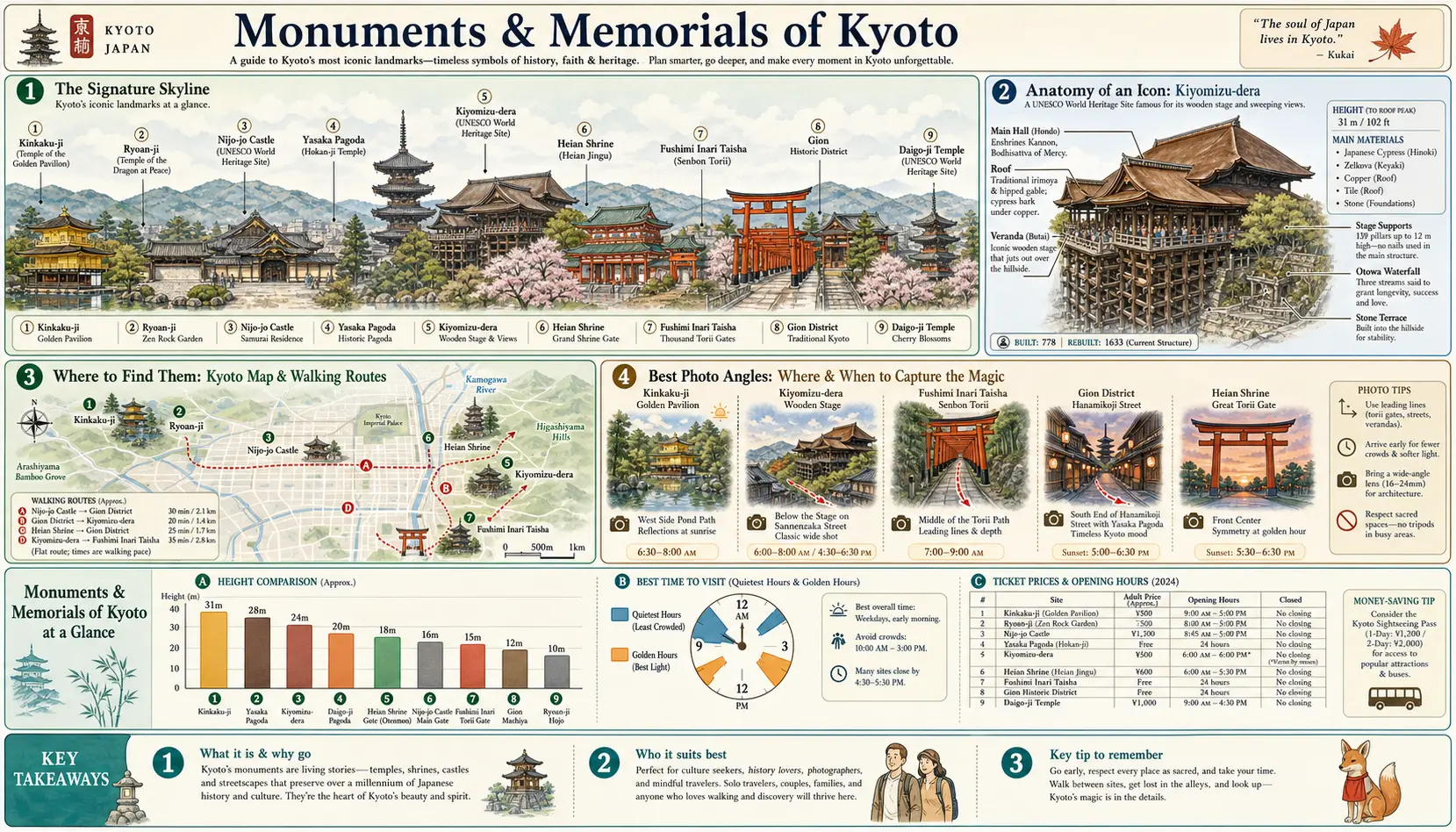
The Hamaguri Gate on the western side of Kyoto Gyoen still shows the pockmarks left by rifle fire in 1864, when a failed revolt against the shogunate set off a blaze that burned much of the surrounding city. Kyoto's monuments tend to work like that — less about reverence than about power, engineering and who was in charge. The five-storey pagoda at To-ji is a fifty-five-metre timber structure that has survived four rebuildings, and Nijo Castle is a political statement with a floor designed to squeak.
Statements of power
Nijo Castle, on the Tozai subway line, was built in 1603 as the shogun's Kyoto residence and is where the last of them handed authority back in 1867; the Ninomaru Palace interiors, painted screens and nightingale corridors are the highlight, and the outer moat circuit adds another half hour. To-ji's pagoda, a short walk from Kyoto Station, is the tallest wooden tower in Japan and the easiest in the city to photograph at dusk. Kyoto Gyoen, the walled park around the old Imperial Palace, is free to enter, and the palace enclosure itself no longer needs an advance permit.
Memorials worth the detour
Above Higashiyama, the Ryozen Kannon is a twenty-four-metre concrete figure raised in the mid-1950s for Japan's war dead, with an adjoining hall commemorating unknown Allied soldiers — an unusual thing to find in Japan and quietly maintained. The Ryozen Museum of History next door covers the upheaval of the 1860s, and the graves of Sakamoto Ryoma and Nakaoka Shintaro sit on the slope above with a wide view over the basin. Down near Higashiyama-Shichijo, Mimizuka is a grassy mound raised over trophies taken during the 1590s invasions of Korea, grim and barely explained on site.