Mosques and Islamic Heritage in Kyoto
A visual guide from the Kyoto travel guide — see all posters in Visual Guides.
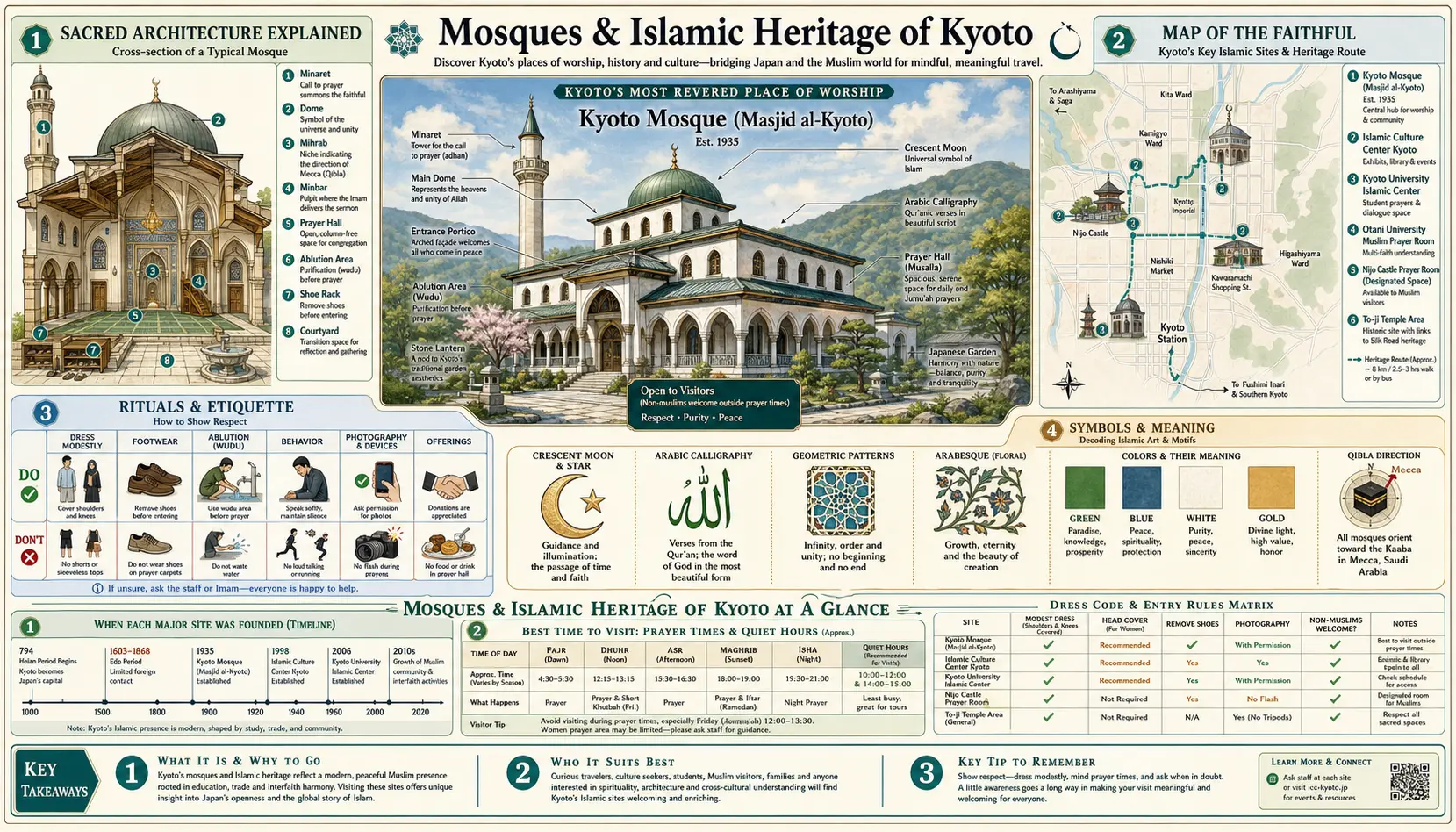
Kyoto Masjid opened in 2016 in a converted building a few minutes from Imadegawa station, close to Doshisha University, and it functions largely as a student and traveller mosque — a prayer hall, a small library and Friday congregations drawn from across the city's universities. Japan's Muslim population is small but growing, and Kyoto has adapted faster than most places: halal ramen counters near Higashiyama, prayer rooms in the bigger retail complexes, and a city tourism office that publishes its own guide to both.
Praying and eating
Kyoto Masjid, near Karasuma-Imadegawa on the subway, is the main congregational space, with the university association running a smaller room to the north-east. Several department stores and complexes around Kyoto Station keep multi-faith prayer rooms, as do a few of the larger hotels and the Kyoto Handicraft Center; asking at an information desk is more reliable than assuming. For food, halal-certified ramen shops operate near Yasaka and around Kyoto Station, alongside Indian, Turkish and Pakistani kitchens in the centre. Confirm certification directly, since small operators change hands often.
The wider heritage
The deeper history sits on the coast rather than in Kyoto. Kobe Muslim Mosque, built in 1935 by Indian, Turkish and Tatar traders, is the oldest in Japan and came through both the 1945 air raids and the 1995 earthquake; it is roughly an hour from Kyoto Station on the JR Special Rapid to Sannomiya, then a ten-minute walk uphill into the Kitano district. Osaka has larger congregations, at Ibaraki and Nishi-Yodogawa. Visitors are generally welcome outside prayer times at Kobe, with the usual expectations on dress and photography.