Komodo Dragons in Komodo Island
Part of the Komodo Island travel guide — see every topic in All Komodo Island Guides.
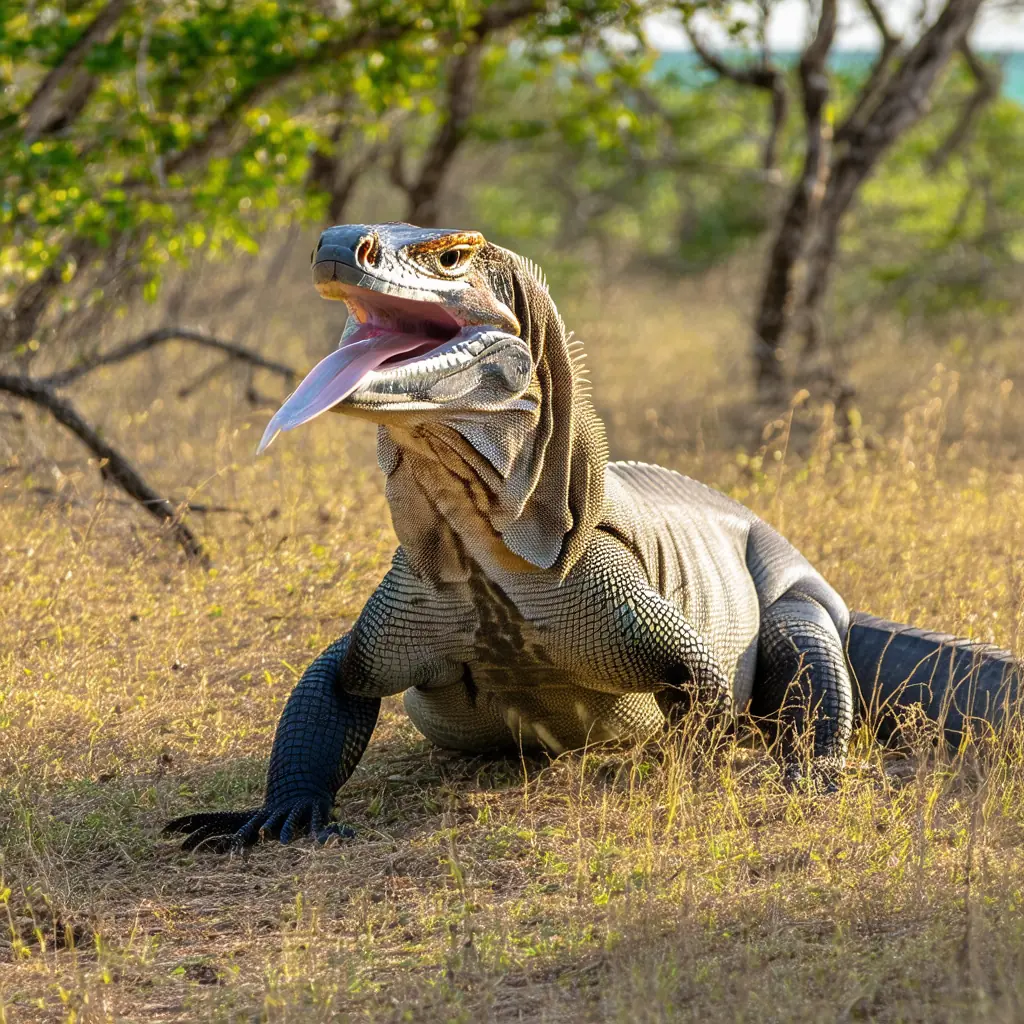
Varanus komodoensis reaches three metres and around ninety kilograms, and exists in the wild only on Komodo, Rinca, Gili Motang, Nusa Kode and a strip of western Flores. There are roughly three thousand of them. They were unknown to science until 1910, and the national park was created in 1980 specifically to protect them. Seeing one is straightforward — a guided walk of one to two hours on Komodo or Rinca, with a ranger carrying a forked stick — but the animal is a genuine predator and the rules exist for a reason.
The animal
Komodo dragons are ambush predators that take deer, water buffalo, wild boar and, occasionally, each other. The old story that their bite kills through septic bacteria has been superseded: research published in 2009 identified venom glands in the lower jaw producing compounds that lower blood pressure and prevent clotting, so prey bitten once bleeds out and is tracked by scent over the following days. They can run at around twenty kilometres an hour in short bursts, swim between islands, and detect carrion from several kilometres using a forked tongue and the Jacobson's organ in the roof of the mouth.
Where and how you see them
Two islands take visitors: Komodo itself, where Loh Liang is the main ranger post, and Rinca, where Loh Buaya was rebuilt with an elevated boardwalk that lets you watch dragons from above. Rinca is closer to Labuan Bajo, has a higher density of dragons, and most day trips go there. Walks are short, medium or long — roughly one, two or three hours — and a ranger accompanies every group. Dragons congregate near the ranger stations, which is honest to acknowledge: sightings there are close to guaranteed, while a long trek gives you a better chance of seeing one behaving naturally.
The rules, and why
Stay with the ranger and behind the stick. Keep at least five metres away and never get between a dragon and cover. Do not run — it triggers pursuit. Move as a group rather than spreading out. Women who are menstruating must tell the ranger, who will keep the group tighter: the animals track blood by scent, and this is a standing park rule rather than superstition. Attacks are rare but real, and have killed both visitors and villagers over the decades. There is no antivenom and the nearest hospital is a boat ride away.
Timing and conditions
Dragons are most active in the morning and again in the late afternoon; through the middle of the day they lie in shade and do very little, which still photographs well but is less interesting. The dry season, April to November, is the standard visiting window and the islands are brown and savanna-like. Mating season around July and August makes males more mobile and more aggressive. Nesting females guard mounds between September and January and should be given a wide berth. Bring water, a hat and closed shoes — the walking is on dry, stony ground with no shade.
Komodo Dragons at a glance
| Species | Varanus komodoensis — up to 3 m, ~90 kg |
|---|---|
| Wild range | Komodo, Rinca, Gili Motang, Nusa Kode, west Flores |
| Population | Roughly 3,000 |
| Venom | Confirmed 2009 — anticoagulant, not septic bacteria |
| Where to see them | Loh Buaya on Rinca (boardwalk) or Loh Liang on Komodo |
| Rules | Stay with the ranger, 5 m minimum, never run |