Manta Rays in Komodo Island
Part of the Komodo Island travel guide — see every topic in All Komodo Island Guides.
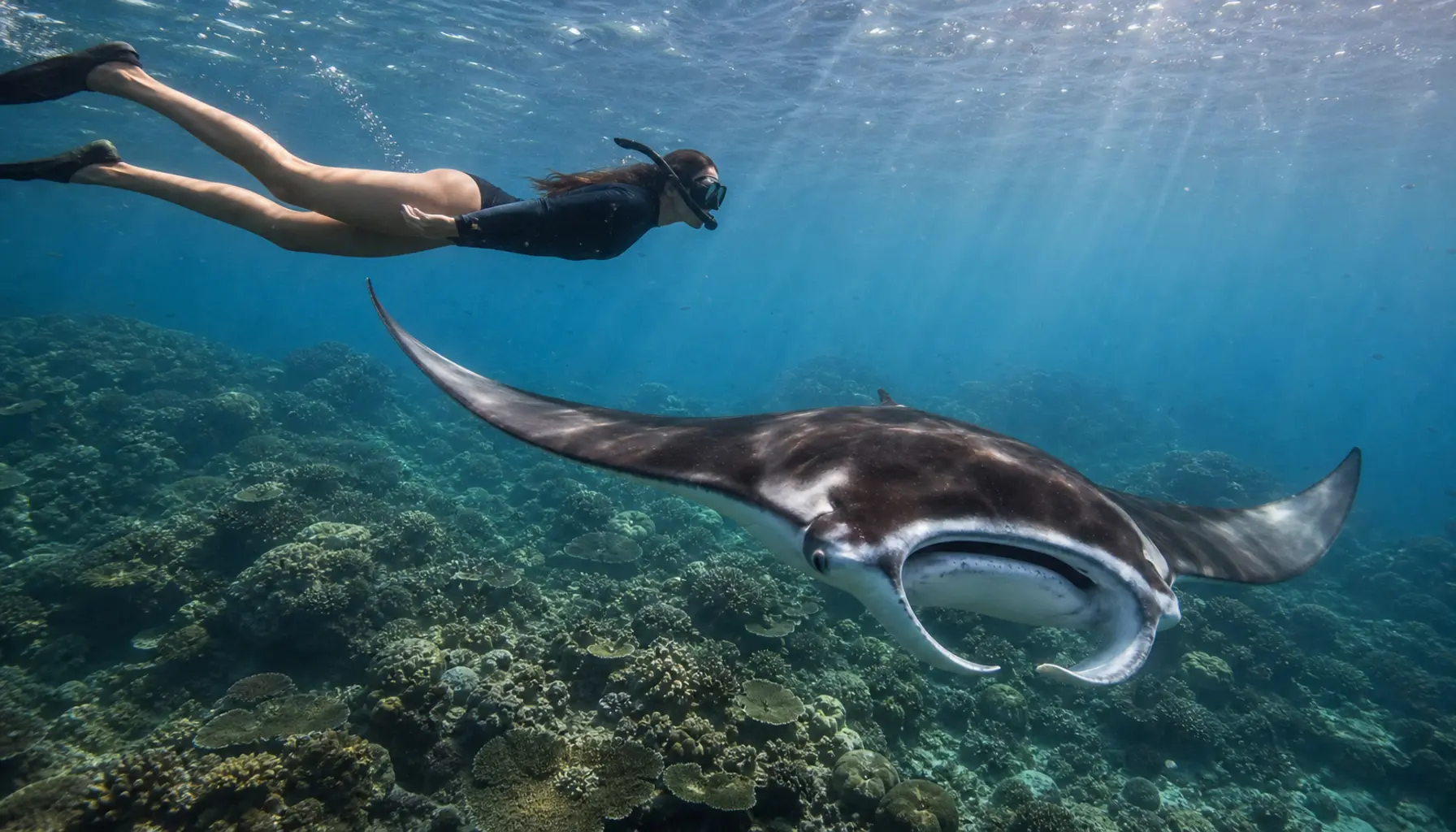
Komodo holds one of the most reliable reef manta aggregations in the world. Mobula alfredi with wingspans of three to four metres gather at cleaning stations, where small wrasse pick parasites from their skin and gills, and at feeding channels where the tidal current concentrates plankton. Sightings run high year-round, peaking in the plankton-rich months. Unusually, the mantas here often feed and cruise close to the surface, which makes Komodo one of the few places where snorkelling with them is genuinely as good as diving.
Where they gather
Karang Makassar — universally called Manta Point — is a long, shallow rubble ridge in the central channel where mantas queue at cleaning stations and drift-feed in the current. It is the standard stop on every day trip. Mawan and Manta Alley in the south are the other two: Mawan is a shallower, calmer site good for snorkellers, while Manta Alley in the far south is a channel between rocks where dozens can gather in the right conditions, reachable realistically only by liveaboard. Sightings across all three run above eighty per cent in season.
How to behave around them
Mantas are curious and will approach a diver or snorkeller that stays still. The rules that keep that happening: never touch them, never chase, never swim over the top of one, and stay out of the cleaning station itself — if you sit on the station, the wrasse leave and the manta does not get cleaned. Approach from the side and below, and stay low. Bubbles from directly beneath will move them off. Do not use flash close in. A boat that drops six people directly onto a feeding line is doing it wrong, and the good operators brief this properly.
Season and conditions
Mantas are present all year. Numbers rise with plankton, which peaks broadly from December to March in the wetter months and again in the cooler upwelling around July and August, though the pattern varies. Currents at Karang Makassar are strong and directional, and the standard approach is a drift — you enter upstream, fly along the ridge and get picked up downstream. Snorkellers should always be with a boat that is following, never swimming back to a fixed anchor point, because the current here will beat any swimmer.
The conservation angle
Indonesia declared the world's largest manta sanctuary in 2014, banning fishing and export of manta rays across its entire exclusive economic zone. The economic argument was decisive: a live manta generates far more revenue over its lifetime through tourism than a dead one does through the gill-plate trade. Mantas are individually identifiable by the spot pattern on their underside, and several research projects welcome photographs from visitors for their identification databases — a good reason to shoot the belly rather than the silhouette.
Manta Rays at a glance
| Species | Reef manta, Mobula alfredi — 3–4 m wingspan |
|---|---|
| Main site | Karang Makassar (Manta Point), central channel |
| Also | Mawan; Manta Alley in the far south (liveaboard) |
| Season | Year-round; peaks with plankton blooms |
| Snorkelling | Genuinely viable — they feed near the surface |
| Rules | No touching, no chasing, stay off the cleaning station |