Street Art and Murals in Kyoto
A visual guide from the Kyoto travel guide — see all posters in Visual Guides.
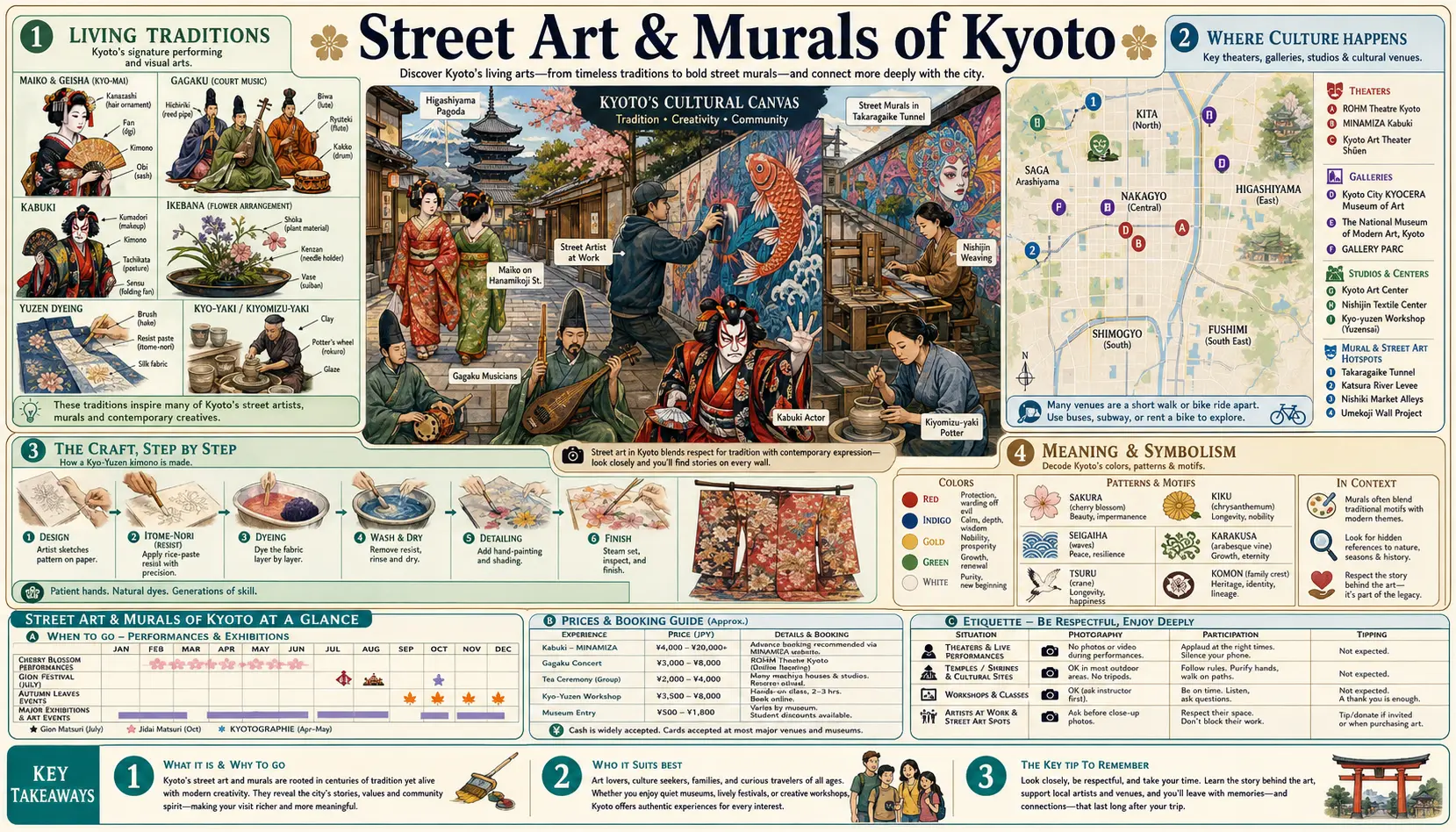
Kyoto legislated the billboards off its own skyline. The 2007 landscape policy stripped rooftop signs, muted shopfronts down to brown and beige, and made large painted walls close to impossible, which is why the McDonald's on Shijo wears brown and cream instead of red and yellow. So the city's street art works differently here. It appears in festival bursts, on shopping-arcade shutters after closing time, along the concrete embankments of the Kamo River, and inside repurposed schools where contemporary galleries have moved in. Finding it is less about wandering and more about knowing which weeks and which back streets pay off.
Where to look
The Kamo River embankment between Sanjo and Demachiyanagi carries the most consistent unofficial work, tags and larger pieces on the flood walls, best seen walking the west bank towards dusk. Shutter art appears in the older arcades once shops close: Sanjo-kai west of Senbon and Demachi Masugata north of the river delta are the two worth timing for early evening. For sanctioned work, the Kyoto Art Center in Nakagyo occupies the former Meirin elementary school and keeps its classrooms as galleries, while the Kyoto International Manga Museum nearby, in another old school, commissions illustration across its grounds and walls.
When it peaks
Two festivals do most of the heavy lifting. KYOTOGRAPHIE, usually mid-April into May, hangs huge photographic works inside machiya townhouses, temple halls, disused banks and industrial spaces across the city, with the fringe KG+ programme filling smaller venues; a single passport ticket covers the main sites and several are walkable in an afternoon. Nuit Blanche Kyoto, normally an October Saturday evening, turns Okazaki and the Nijo area over to projections and light installations, most of it free. Outside those windows expect a quieter city, since Osaka and Kobe are where Kansai's big-wall mural scene actually lives.