Street Food Guide in Kyoto
A visual guide from the Kyoto travel guide — see all posters in Visual Guides.
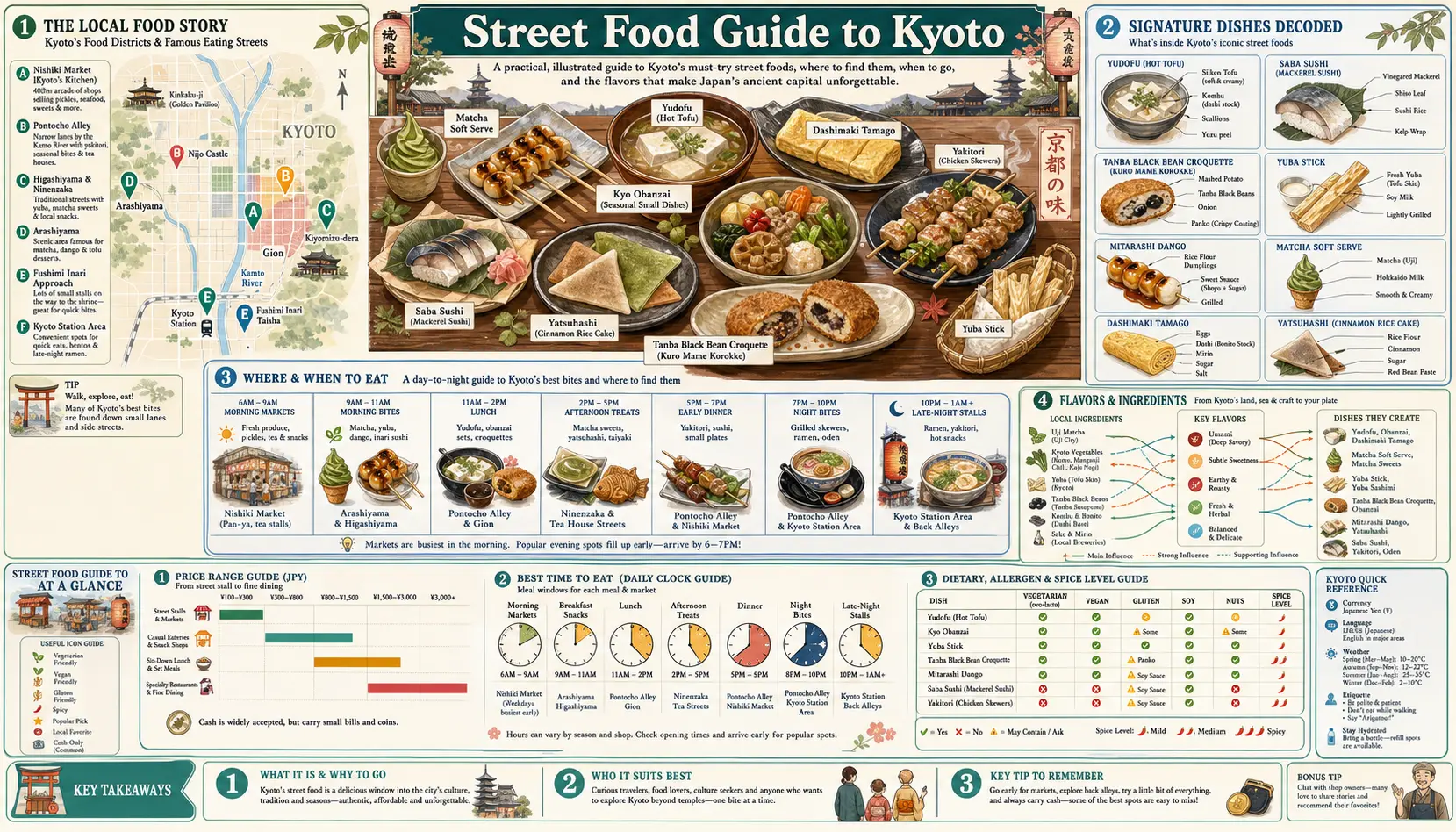
Kyoto is not a stall city. There are no night bazaars of woks and no pavement plastic stools, and Nishiki Market has posted signs asking people not to eat while walking. What it has instead is a dense run of counter shops, arcade snack stands and department-store basements where a few hundred yen buys something made the same way for generations: tamagoyaki sliced hot off the pan, tako tamago skewers with a quail egg tucked into the octopus head, soy-milk doughnuts, warm bean mochi eaten on a bench by the river.
Where to graze
Nishiki Market runs about 400 metres east from Karasuma to Teramachi, a covered lane one block north of Shijo. Arrive before eleven or after three to avoid the crush, then work east through tamagoyaki, pickles, sesame doughnuts, grilled scallops and soy-milk soft serve. North of the Kamo delta, the Demachi Masugata arcade is the local counterweight, with Demachi Futaba's bean mochi drawing a queue that moves faster than it looks. Kyoto Station covers the rest: a ramen floor high up on the Isetan side gathers shops from several regions, and the Porta and Cube basements handle bento and sweets.
How to eat it well
Stand still to eat. Most stalls put out a small counter or a bin for used skewers, and using them is expected rather than optional. Carry coins, because plenty of the older shops still prefer cash even where IC cards are accepted. Portions are deliberately small, so plan on grazing five or six things rather than committing to one. For an evening version, the standing bars along Kiyamachi and the lanes off Pontocho serve skewers and small plates late, and from roughly May to September the riverside yuka platforms over the Kamo turn dinner into an outdoor event.