Suburban Escapes in Kyoto
A visual guide from the Kyoto travel guide — see all posters in Visual Guides.
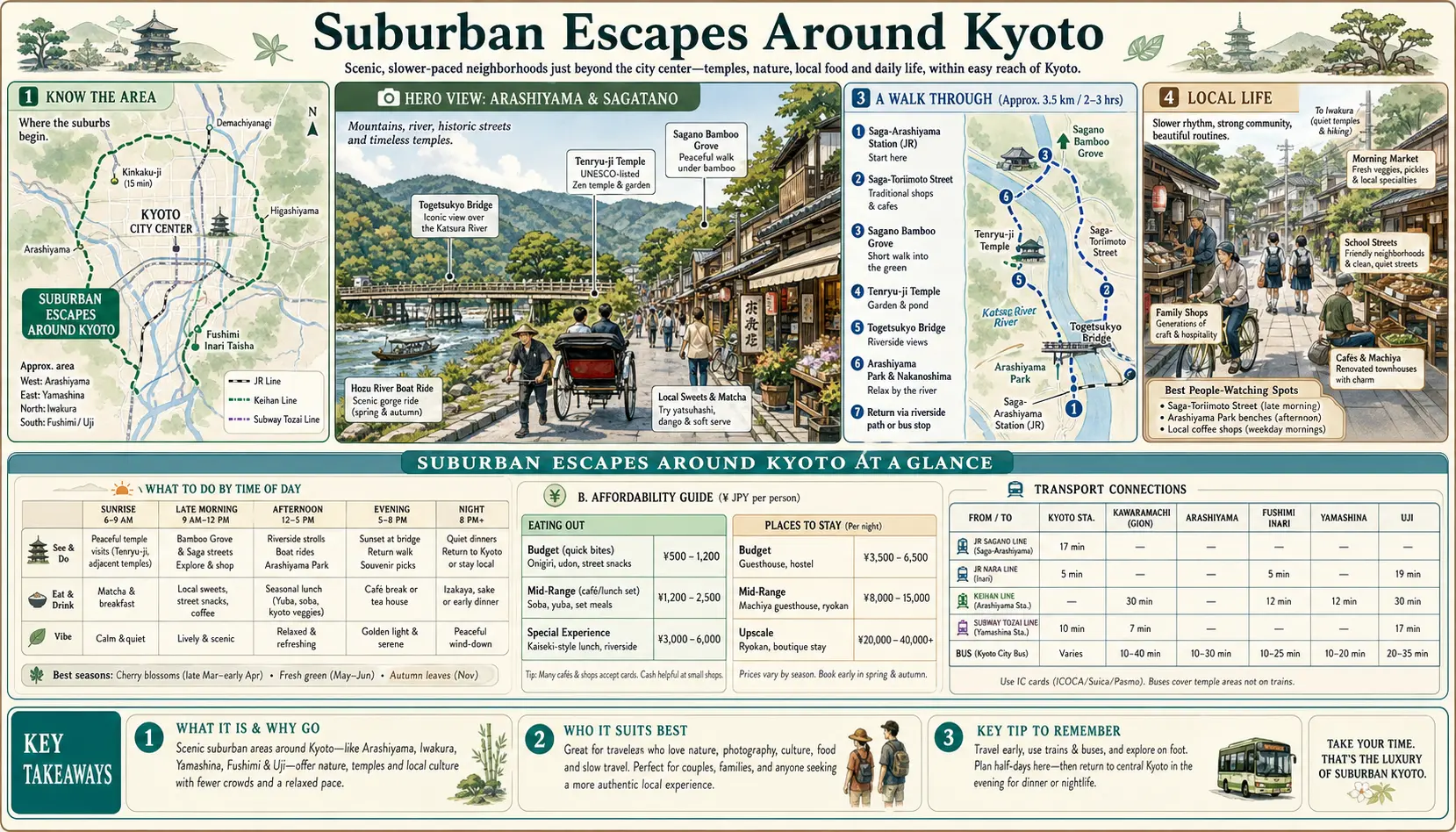
Kyoto's basin is small and the trains out of it are fast. Twenty minutes south on the Nara line the tea fields and river bridges of Uji begin. Half an hour north on the Eizan Railway the temperature drops several degrees as the line climbs through cedar towards Kurama. Fushimi's sake warehouses sit along a canal you can ride a flat-bottomed boat down, and Ohara is a working farm valley reached by a single bus. None of these needs an overnight bag, and all of them empty out the moment the day-trip coaches leave.
Half-day runs
Uji is the easiest, roughly twenty minutes on the JR Nara line from Kyoto Station, or Keihan from Sanjo with a change at Chushojima. The riverfront concentrates the tea houses, Byodo-in's Phoenix Hall, the building on the ten-yen coin, and the city-run Taiho-an tearoom, which offers short and inexpensive sittings. Fushimi's sake district is a Keihan ride to Chushojima: plaster-and-timber warehouses lining the canal, the Gekkeikan Okura museum with a tasting at the end, and a small passenger boat working the canal in season. Either one fits comfortably into an afternoon.
Full days worth the ride
Kurama and Kibune are the summer answer. The Eizan Railway from Demachiyanagi takes about half an hour, and the ridge trail between the two villages needs roughly an hour on foot with a steady climb in the middle. From late May to September, Kibune's restaurants build kawadoko platforms directly over the stream, which is about as cool as Kyoto gets in August. Ohara is one bus from Kyoto Station, around an hour, or twenty minutes from Kokusaikaikan, and delivers terraced shiso fields, moss gardens and very little traffic. For open water, Otsu on Lake Biwa is barely ten minutes by JR.