Malacca
A red Dutch square, a Peranakan night market, and five hundred years of trade in one small town.
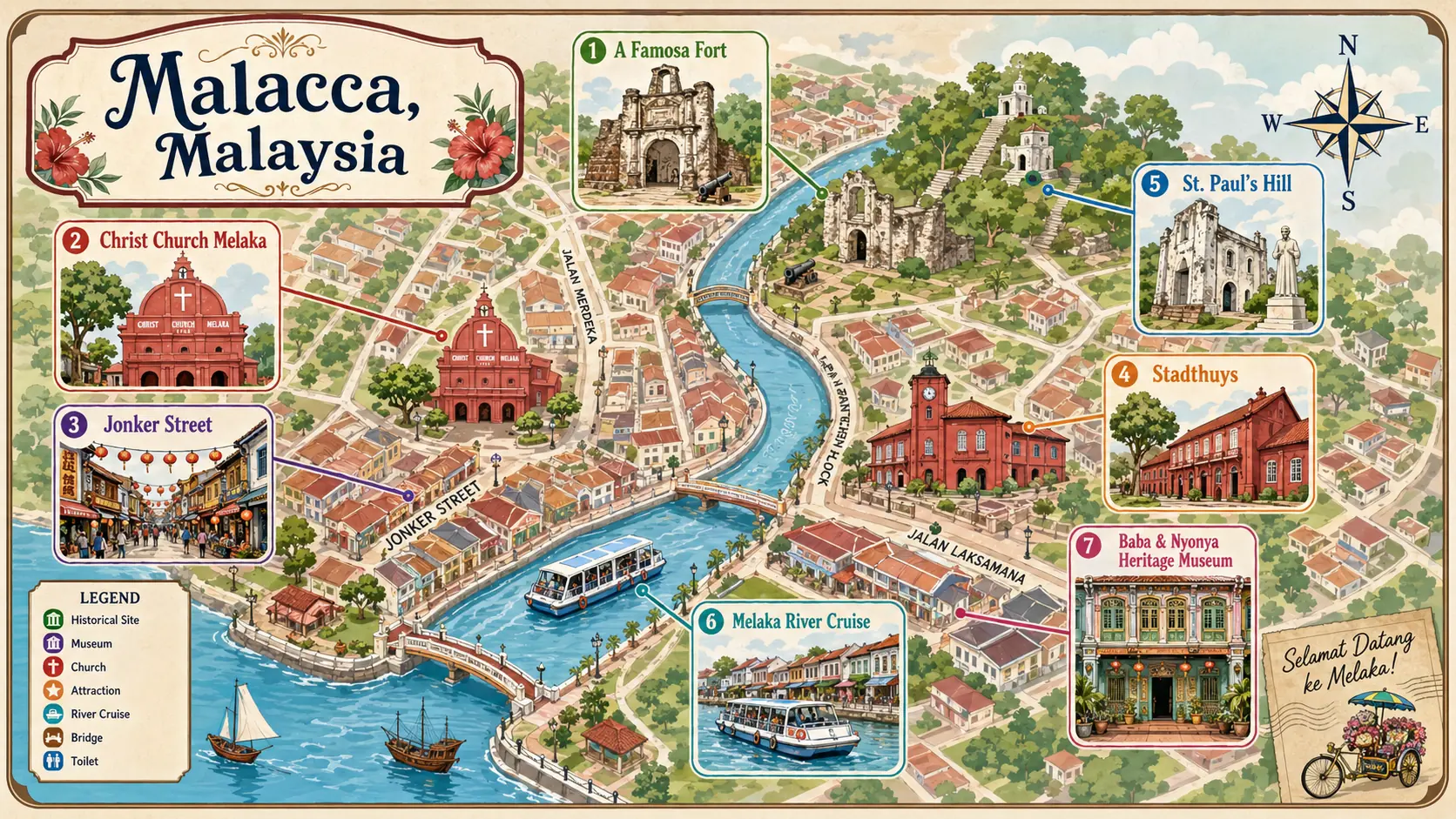
Melaka — spelled Malacca in English — was the great trading port of the strait that bears its name, ruled in turn by a Malay sultanate, the Portuguese, the Dutch and the British, each of whom left their stamp. The result is a small, walkable UNESCO city where a Dutch town square sits across the river from a Chinatown of Peranakan shophouses, a ruined Portuguese fort overlooks the lot, and the food is a cuisine all its own. It is an easy two-hour bus ride south of Kuala Lumpur and makes a perfect overnight or weekend; come for the heritage by day and the night market by dark.
What to do in Melaka
The historic core sits on both banks of the narrow Melaka River. Start at the famous red square, climb the hill to the fort and church ruins for the view, then cross the river into Chinatown for the heritage houses and, after sunset, the market. It is comfortably a one-full-day plan with an evening to spare.
- Dutch Square (Red Square) — the terracotta-red Stadthuys (the old Dutch town hall, now a museum) and Christ Church, the most photographed colonial buildings in Malaysia, with a kitsch flotilla of LED-festooned trishaws parked out front.
- A Famosa & St Paul’s Hill — the Porta de Santiago gateway is all that fully survives of the Portuguese fort; climb the hill behind it to the roofless ruin of St Paul’s Church for breeze and views over the strait.
- Jonker Street (Jalan Hang Jebat) — the spine of Chinatown, lined with antique shops, clan temples and cafes by day, and transformed into a buzzing weekend night market (Friday to Sunday) of food stalls, buskers and bargain stalls.
- Baba-Nyonya Heritage Museum — a beautifully preserved Peranakan townhouse that tells the story of the Straits-Chinese culture born from Chinese–Malay intermarriage, from carved screens to wedding finery.
- The river cruise — a 45-minute boat down the Melaka River past muralled walls and waterfront cafes; best at dusk when the lights come on.
What to eat in Melaka
Melaka’s table is Nyonya — the Straits-Chinese cooking that blends Chinese technique with Malay spice — alongside a few local oddities. The signature dish is chicken-rice balls: the usual Hainanese poached chicken, but with the rice rolled into ping-pong-sized balls, a Melaka quirk you should try at least once.
- Nyonya laksa & ayam pongteh — coconut-curry noodles and a soy-and-fermented-bean braised chicken, the heart of Peranakan home cooking.
- Cendol — Melaka’s version, drowned in thick Gula Melaka (local palm sugar) and coconut milk, is some of the best in the country.
- Satay celup — a Melaka invention: skewers of seafood, meat and vegetables you cook yourself in a communal pot of bubbling satay sauce.
How to get to Melaka
The simplest approach is the express coach from Kuala Lumpur’s TBS terminal — frequent departures, about two hours to Melaka Sentral, then a short local bus (route 17) or Grab into the historic centre. There is no direct rail line into the old town. Coaches also run south to Singapore (around four hours). The historic core itself is small enough to cover entirely on foot.
Where to stay in Melaka
Stay in Chinatown, on or just off Jonker Street, where restored Peranakan shophouses have become boutique guesthouses and the night market is on your doorstep. The Dutch Square and riverside are a two-minute walk over the bridge. Weekends fill up with KL and Singapore visitors, so book ahead if your dates land on a Jonker market night.
Melaka slots easily into a peninsular loop with Kuala Lumpur two hours north, and pairs well with the food of Penang and the cool hills of the Cameron Highlands on a longer west-coast itinerary.