Penang
George Town’s peeling shophouses, painted walls, and the best plate of noodles in the country.
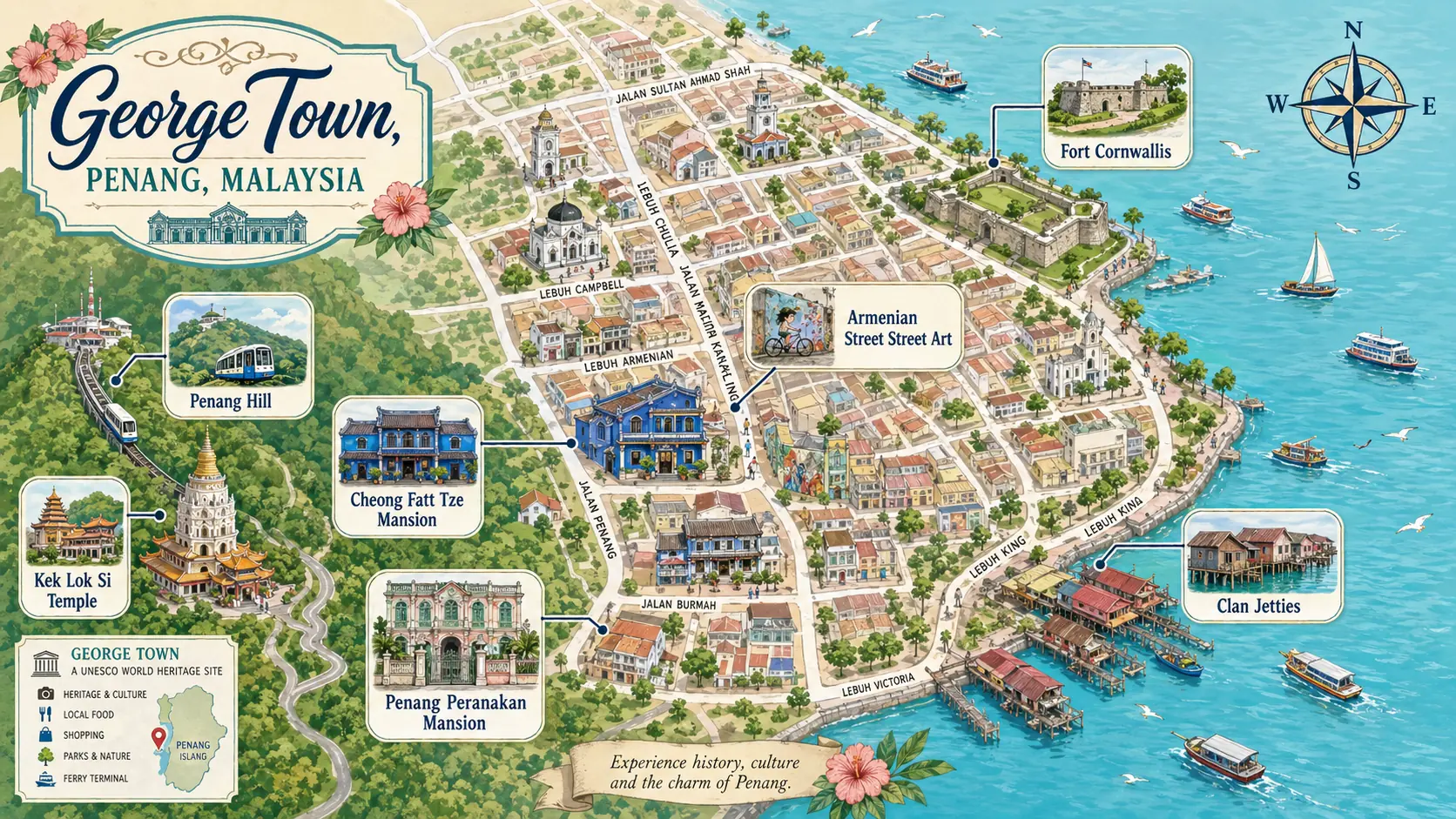
Penang is an island off the northwest coast where Malaysia’s cultures pressed together hardest, and its capital, George Town, is the result — a UNESCO World Heritage city of two-storey shophouses, clan temples, mosques and churches that the British, Chinese, Indian and Malay communities built shoulder to shoulder. It is a place to walk slowly: peeling pastel facades, the smell of joss sticks and frying garlic, an old bicycle painted onto a wall by a Lithuanian artist. Most visitors come for two reasons — the heritage and the hawker food — and stay a day longer than they planned for both.
What to do in George Town
The heritage core is compact and best explored on foot or by trishaw. Spend a morning on the street art trail, an afternoon at the clan houses and jetties, and an evening eating, and you will have the measure of George Town in a single rewarding day.
- Street art & the Ironwork murals — Ernest Zacharevic’s playful wall paintings (the “Little Children on a Bicycle”, the boy on a motorbike) plus 52 witty wrought-iron caricatures scattered across the old town. Pick up the trail map and let it pull you down lanes you’d otherwise miss.
- The Clan Jetties — stilt-house waterfront settlements built by Chinese clans, of which Chew Jetty is the largest and most atmospheric, especially at sunset.
- Khoo Kongsi — the most ornate Chinese clan house in the country, a riot of carved stone and gilt under a soaring roof.
- Kek Lok Si — the largest Buddhist temple in Malaysia, climbing a hillside in Air Itam with a seven-storey pagoda and a giant bronze Kuan Yin; ride the inclined funicular to the upper terrace.
- Penang Hill — a funicular railway hauls you up to cool air, colonial bungalows and a viewpoint over the whole island and the mainland; pair it with Kek Lok Si in one half-day, both in Air Itam.
Why is Penang the food capital of Malaysia?
Penang is widely held to be the best hawker-food city in Malaysia because its mixed heritage produced dishes found nowhere else, and because whole families have cooked single specialities for generations at the same cart. Eat at the open-air food courts — Gurney Drive, New Lane, Chulia Street — where you order from many stalls to one table.
- Char koay teow — flat rice noodles seared in a smoky wok with prawns, cockles, egg and chives. The benchmark dish.
- Asam laksa — a sour, fragrant mackerel-and-tamarind noodle soup with mint, pineapple and ginger flower; Penang’s signature, and an acquired love.
- Char hokkien mee — here a rich prawn-broth noodle soup (not the dark fried KL version), topped with pork, prawns and fried shallots.
- Cendol & ais kacang — shaved-ice desserts with coconut milk, palm sugar and green rice-flour jelly to cool down between savoury plates.
How to get to Penang
Penang International Airport sits at the south of the island, about 30–45 minutes by Grab from George Town, with frequent flights from Kuala Lumpur, Singapore and regional hubs. By land, the ETS train runs to Butterworth on the mainland, from where a cheap, scenic ferry or a Grab over the long Penang Bridge crosses to the island. Long-distance coaches connect KL, Ipoh and the Cameron Highlands jump-off towns.
Where to stay in Penang
Stay inside the George Town heritage zone — Lebuh Chulia and Love Lane for backpackers and budget guesthouses, the restored Peranakan shophouse-hotels for something special, and the seafront toward Gurney Drive for resort comfort. Almost everything worth seeing in the old town is then a walk or a short trishaw ride away.
Penang pairs naturally with the duty-free beaches of Langkawi to the north (there’s a direct ferry in season) and the cool tea country of the Cameron Highlands inland; many travellers arrive from Kuala Lumpur by train or short flight.