Kuala Lumpur
Twin towers, temple caves, and a street-food lane that doesn’t sleep.
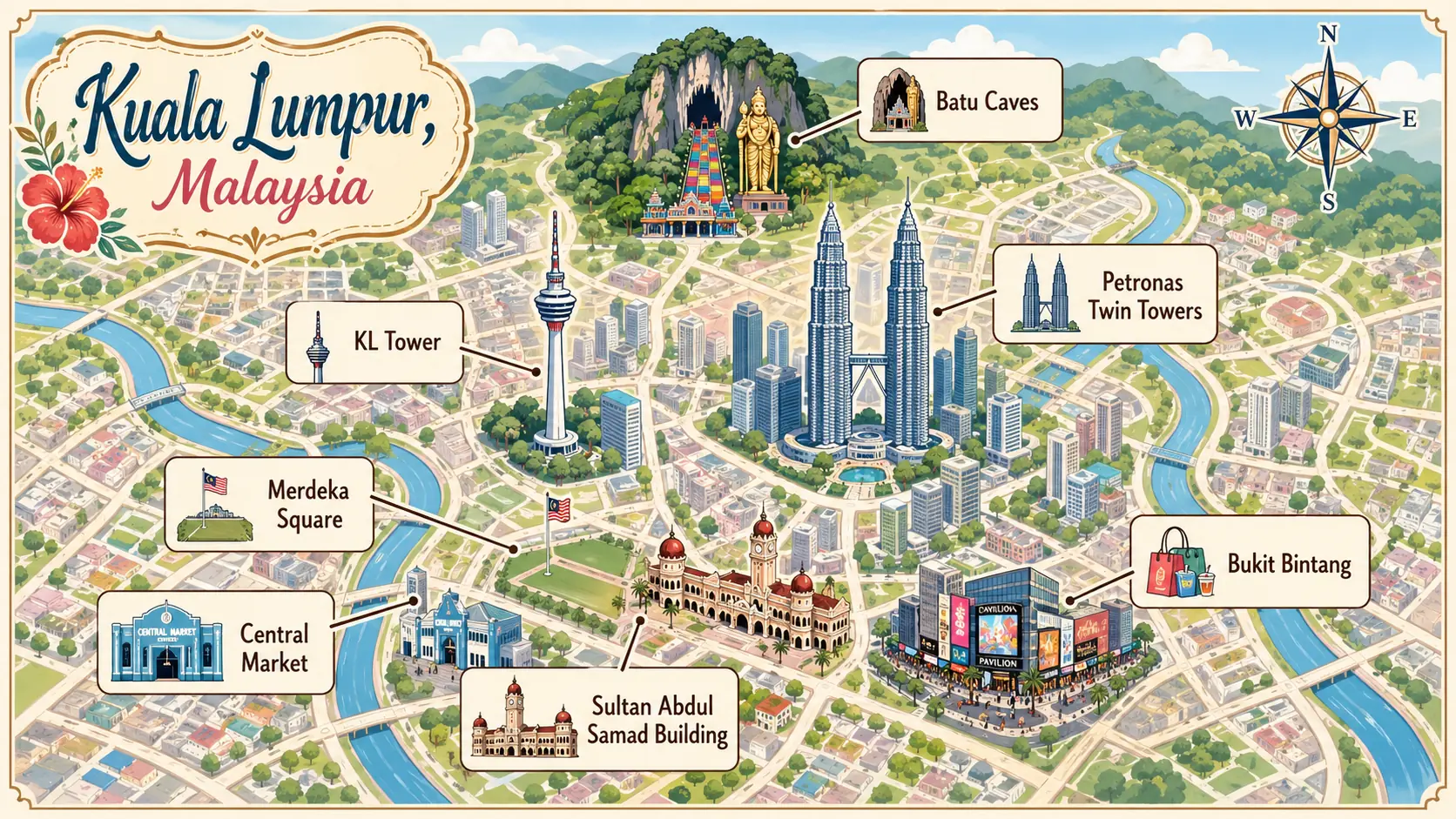
Kuala Lumpur — KL to everyone who lives there — is a city of glass towers growing out of a tin-mining town, and the seams still show in the best way. The colonial core around Merdeka Square sits a short walk from the gilded chaos of Chinatown, which sits beneath the steel of the modern skyline. It is humid, green, and surprisingly walkable in patches, stitched together by an elevated-and-underground rail network and the cheapest Grab rides of any big Asian capital. Give it two full days and you will have seen the icons; give it three and you will have eaten properly.
What to do in Kuala Lumpur
The Petronas Twin Towers are the obvious start — book the skybridge-and-observation-deck ticket online for a morning slot, then come back after dark when the towers and the KLCC park fountains are lit. Most visitors pair the towers with the cave temples and the street-food lane, and call that a city.
- Petronas Towers & KLCC — the 88-storey towers, the Suria KLCC mall at their feet, and the park behind for the classic photograph. The free Lake Symphony fountain show runs nightly.
- Batu Caves — a limestone cavern temple reached up 272 rainbow-painted steps, guarded by a towering golden statue of Lord Murugan, with macaques who will rob you of anything shiny. Twenty minutes north on the KTM Komuter line from KL Sentral.
- Petaling Street (Chinatown) — the covered market of knock-off everything, but go for the Sri Mahamariamman Hindu temple, the Guan Di and Sin Sze Si Ya Taoist temples, and the kopitiam breakfasts.
- Merdeka Square & the colonial quarter — the Sultan Abdul Samad building, the Moorish-revival old railway station, and the riverside “River of Life” confluence that gave the city its name (“muddy estuary”).
- Bukit Bintang — the shopping-and-nightlife district, all malls, rooftop bars and reflexology shops, and the gateway to the food.
Where to eat — Jalan Alor and beyond
Jalan Alor, a lane off Bukit Bintang, is the food memory people carry home: plastic stools spilling into the street, woks roaring, and stalls grilling satay and chicken wings, frying char kway teow, and steaming bamboo clams in chilli. Order grilled stingray with sambal, a plate of Hokkien mee, and an iced sugarcane juice, and graze your way down both sides.
Beyond Jalan Alor, KL’s real specialities are everyday and cheap. Seek out nasi lemak (coconut rice with sambal, anchovies and a boiled egg), banana-leaf curry in the Indian shops of Brickfields, bak kut teh (peppery pork-rib broth), and roti canai with dhal at any mamak stall, eaten with your fingers at midnight. A satisfying meal rarely costs more than 15–25 ringgit.
How to get to Kuala Lumpur
Kuala Lumpur International Airport (KLIA, with its budget-carrier terminal KLIA2) is the main gateway to Malaysia. The fastest way into town is the KLIA Ekspres train — roughly 30 minutes non-stop to KL Sentral, the city’s rail hub, where you change to the LRT/MRT or grab a taxi. A Grab from the airport is cheaper for two or more people but slower in traffic.
KL Sentral is also the heart of the domestic network: ETS intercity trains run north to Ipoh and the Cameron Highlands jump-off at Tapah, and south toward Melaka and Singapore, while frequent budget flights and long-distance coaches reach Penang, Langkawi and beyond. Within the city, a stored-value Touch ’n Go card works on every LRT, MRT and Monorail line.
Where to stay in Kuala Lumpur
First-timers should base themselves in Bukit Bintang or KLCC — central, walkable to the towers and Jalan Alor, and densely served by transit. Chinatown and the surrounding Bukit Bintang fringe hold the best hostels and heritage guesthouses for budget travellers, while the KLCC towers themselves are ringed with skyline hotels and infinity-pool rooftops for a splurge.
Day trips from Kuala Lumpur
- Genting Highlands — a cool-air hilltop resort city of casinos, theme parks and a cable car (the Awana SkyWay), about an hour north and reachable by bus from KL Sentral.
- Putrajaya — the planned federal administrative capital, all lakeside boulevards, the pink-domed Putra Mosque and grand bridges; an easy half-day by train or Grab.
- Batu Caves — close enough to be a half-day rather than a true excursion, but the temple at the top of the steps earns its place.
From here the rest of the peninsula opens up — the heritage shophouses and hawker food of Penang, the red Dutch square of Malacca, and the tea-cool air of the Cameron Highlands.