Taipei
A green-mountain basin of temples, hot springs, and night markets, run by a metro that never lets you down.
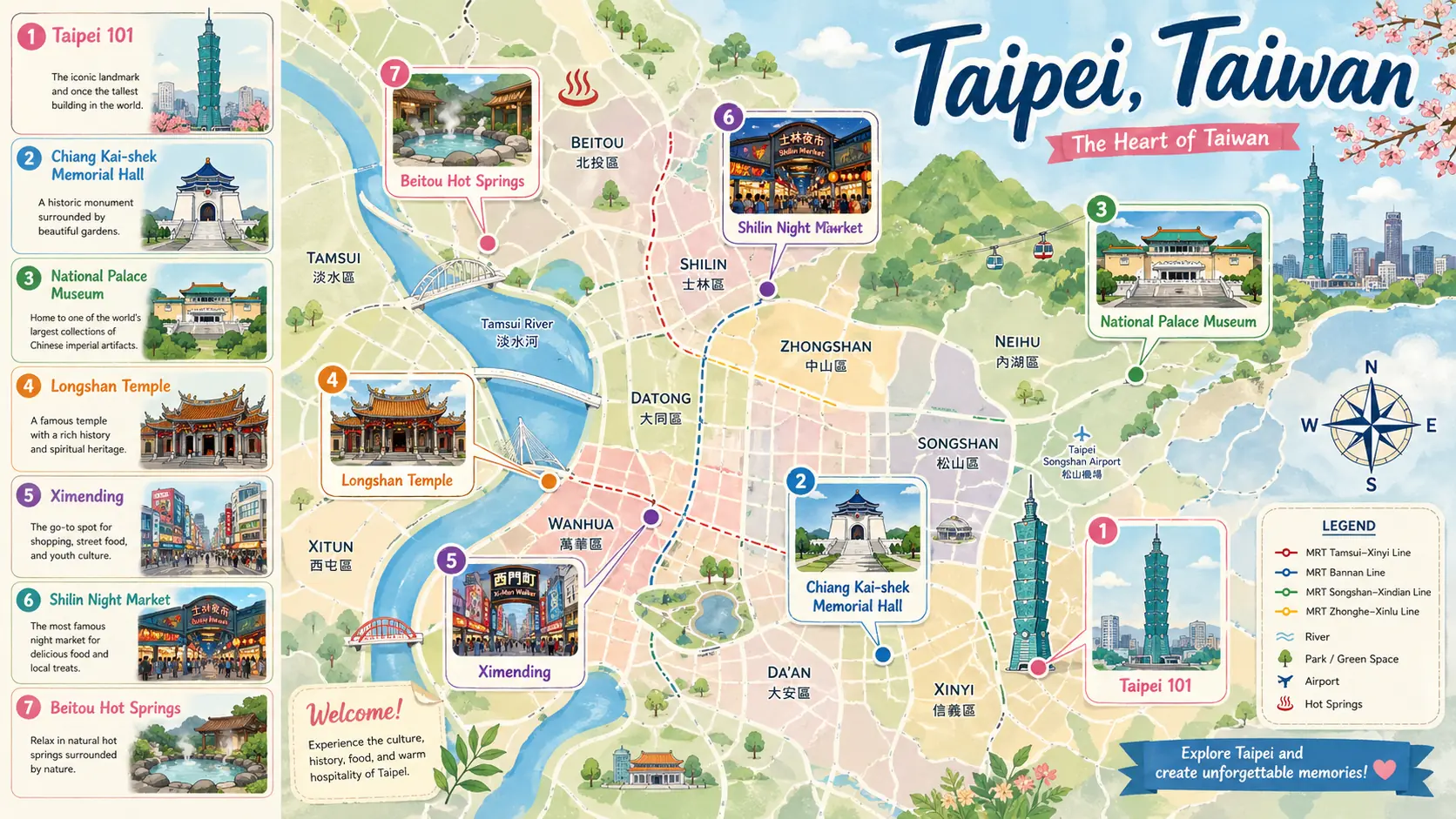
Taipei sits in a bowl ringed by wooded hills, and the city has the unhurried, slightly damp feel of a place that has made its peace with the rain. Taipei 101 — for a few years the tallest building on earth, and still the one the skyline organises itself around — rises out of the Xinyi shopping district; from the observatory you can watch its great gold tuned-mass damper sway against the typhoons. But the real Taipei is at street level: the incense haze of Longshan Temple in the old Wanhua quarter, the late-night sprawl of the Shilin and Raohe night markets, and the steaming sulphur valley of Beitou at the end of a branch line. It is one of the friendliest big cities in Asia, and one of the cheapest to eat well in.
What to do in Taipei
Climb (or lift) up Taipei 101 for the view, then walk the Xinyi district below it. Pay respects at Longshan Temple, the city’s most atmospheric, and the Chiang Kai-shek Memorial Hall, where the hourly changing of the honour guard draws a crowd on the great white-and-blue plaza. Ride the Maokong gondola up over the tea hills south of the zoo for oolong at a hillside teahouse, and set aside an afternoon for Beitou, where you can soak in public hot-spring baths fed by the volcanic Thermal Valley. Cap it in Ximending, the pedestrianised neon district that is Taipei’s answer to Shibuya — all youth fashion, street buskers, and late-night snacks.
- Taipei 101 & Xinyi — the landmark tower and the city’s glossiest district.
- Longshan Temple — 18th-century, gold and dragons, thick with incense.
- Chiang Kai-shek Memorial Hall — the white monument and Liberty Square.
- Maokong gondola — cable car to the tea-growing hills above the city.
- Beitou hot springs — volcanic bathing at the end of an MRT branch.
- Ximending — neon pedestrian quarter for shopping and street food.
Where to eat — the night markets
The night market is the soul of Taipei dining. Shilin is the biggest and most famous, a maze of stalls best known for its oyster omelette and giant fried chicken cutlet. Raohe Street, by the gorgeous Songshan Ciyou Temple, is smaller, easier, and home to the black-pepper buns baked in a clay tandoor at the entrance. Wherever you land, look for beef noodle soup (Taiwan’s unofficial national dish), bubble tea (invented here in the 1980s), stinky tofu for the brave, and the soup dumplings (xiaolongbao) that the city’s most famous restaurant exported to the world.
How to get around Taipei
Buy an EasyCard at any station and you are sorted — it works on the spotless, signposted-in-English MRT, on city buses, and in convenience stores. From the airport, the Taoyuan Airport MRT runs straight into Taipei Main Station in about thirty-five minutes on the express service, far simpler than a taxi.
Taipei is also the launch pad for the rest of the north: the red-lantern hill town of Jiufen and the Pingxi sky-lantern line are an easy day trip east, while the High-Speed Rail south reaches the temple city of Tainan and harbourside Kaohsiung in under two hours.