Climbing Mount Kinabalu in Borneo (Sabah)
Part of the Borneo (Sabah) travel guide — see every topic in All Borneo (Sabah) Guides.
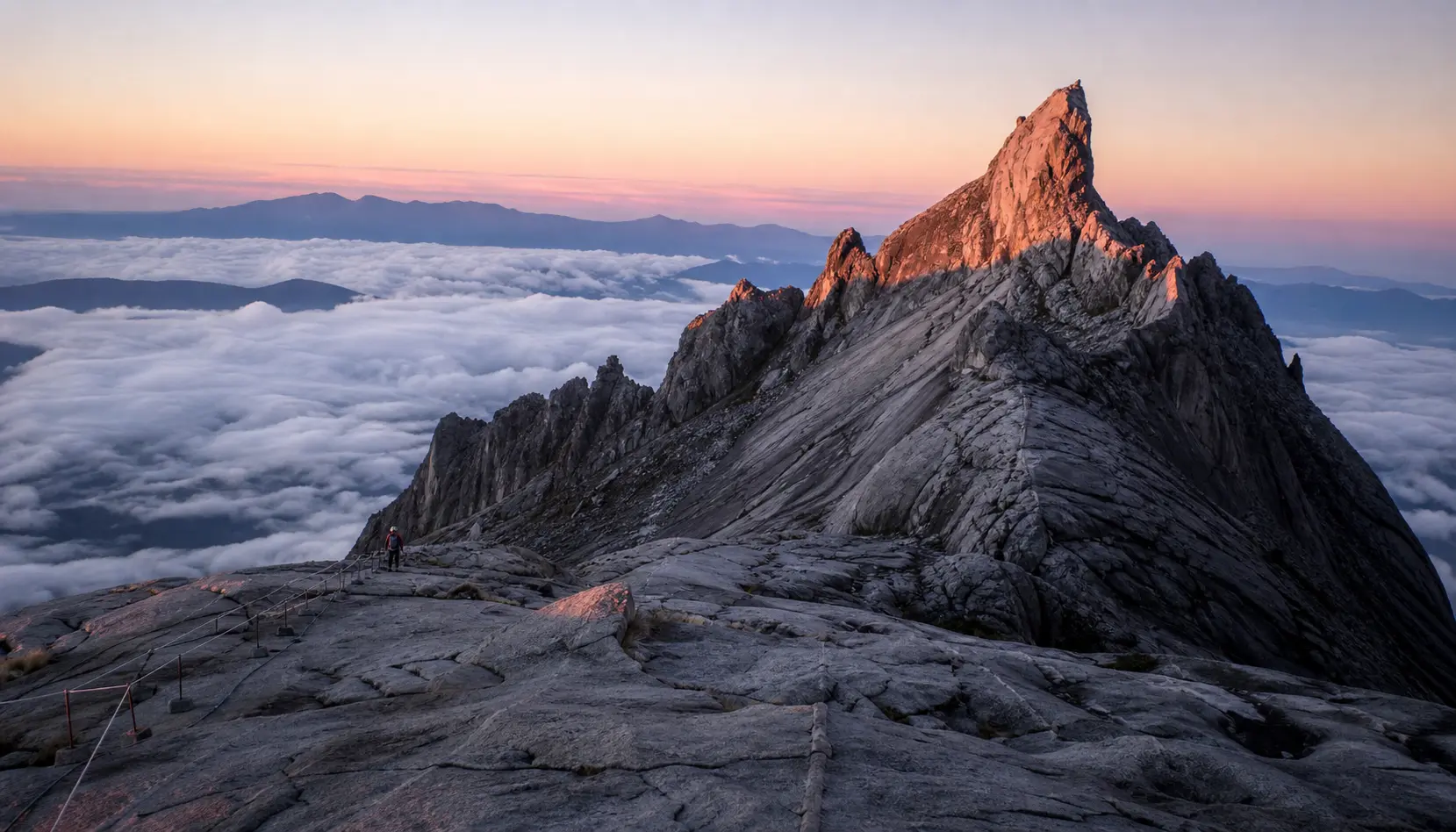
Mount Kinabalu rises to 4,095 metres, the highest peak between the Himalaya and New Guinea, and its summit is reachable by any reasonably fit person over two days with no technical climbing. That accessibility is why permits are capped and why booking months ahead is essential: a limited number of climbers are allowed on the mountain each day, tied to bed space at the mountain huts, and a licensed guide is compulsory. Kinabalu Park was inscribed as Malaysia's first UNESCO World Heritage Site in 2000.
How the climb works
Day one is a six-kilometre climb from Timpohon Gate at 1,866 metres to the huts at Laban Rata around 3,270 metres, taking four to six hours on a stepped and rooted trail through montane and then stunted summit forest. You sleep at the huts, eat an early dinner, and start again at around two in the morning. Day two is the summit push: three to four kilometres and 800 vertical metres over bare granite, partly on fixed ropes, to reach Low's Peak for sunrise, then the whole descent back to the gate.
Permits and booking
A climbing permit, an insurance fee, a park entry fee and a licensed mountain guide are all compulsory, and the number issued per day is capped — historically in the range of a couple of hundred, and lower after the 2015 earthquake damaged the routes. Permits are tied to accommodation at Laban Rata, which is the binding constraint. In practice you book a package through an authorised operator two to six months ahead, more for weekends and holidays. Total cost typically runs 1,200–2,500 ringgit per person for a two-day, one-night climb including everything.
How hard it is
Not technical, but genuinely demanding. The distance is short and the vertical gain is large, the steps are relentless, and the summit push is at altitude in the dark and cold. Altitude sickness affects a meaningful minority at Laban Rata and above — headache, nausea, breathlessness — and the standard advice is to ascend slowly, drink constantly and turn back if symptoms worsen. Summit temperatures can be near freezing with wind. The descent is harder on the knees than the ascent is on the lungs. Poles help enormously.
The via ferrata and the 2015 earthquake
Kinabalu carries what has been described as the world's highest via ferrata, a protected climbing route with fixed cables and rungs across the granite face at around 3,700 metres, run as an add-on for climbers who have already reached Laban Rata. A magnitude 6.0 earthquake in June 2015 killed eighteen people on the mountain, damaged the summit trail and destroyed the Sabah landmark of the Donkey's Ears. Routes were rebuilt and reopened, and the mountain now operates with revised trails and lower daily numbers.
Climbing Mount Kinabalu at a glance
| Height | 4,095 m — highest between the Himalaya and New Guinea |
|---|---|
| Format | 2 days, 1 night at Laban Rata (~3,270 m) |
| Compulsory | Permit, insurance, park fee and a licensed guide |
| Booking | 2–6 months ahead — permits are capped |
| Cost | RM 1,200–2,500 per person, all in |
| Summit push | Starts ~2am; near-freezing with wind |