Rice Terraces and Countryside in Bali
Part of the Bali travel guide — see every topic in All Bali Guides.
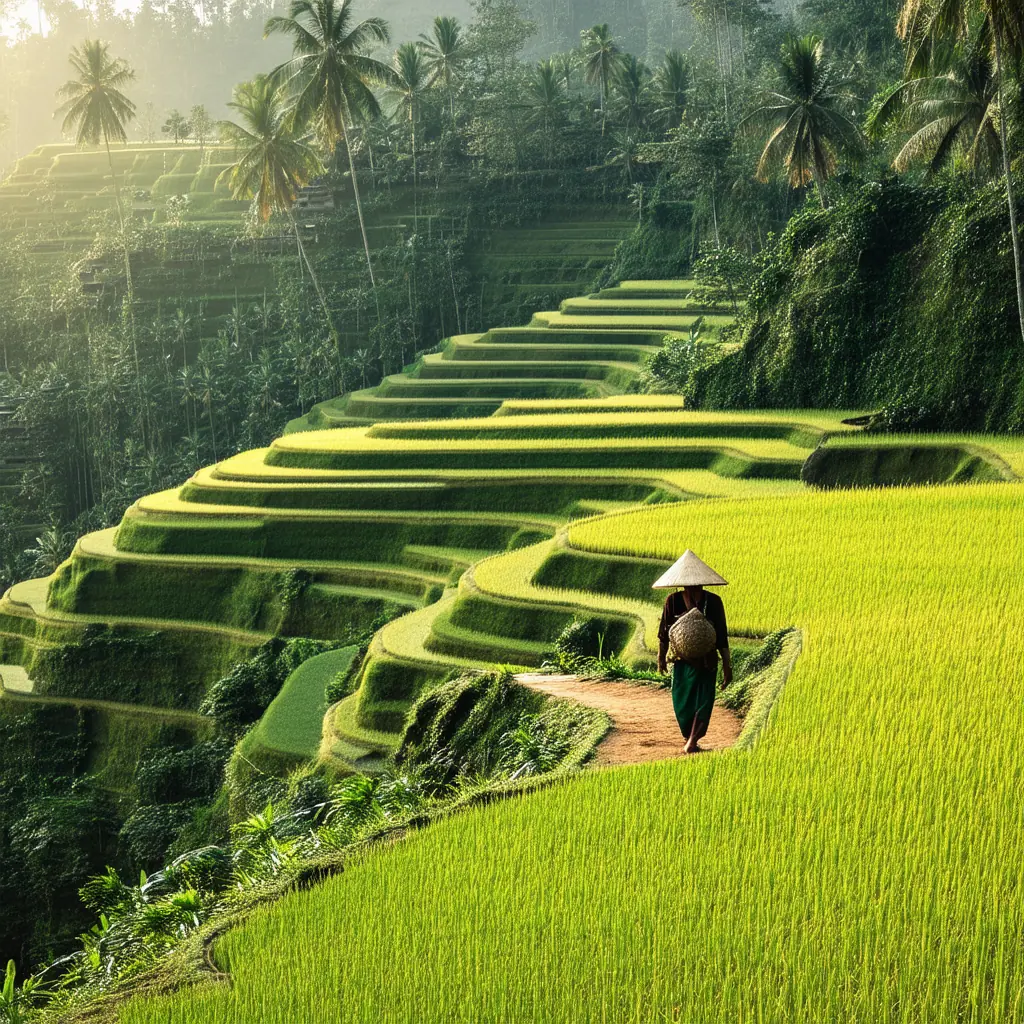
The terraces are not scenery, they are infrastructure. Bali's subak system — a network of canals, tunnels and weirs managed by farmer cooperatives that has run since roughly the ninth century — distributes water from the crater lakes down the mountainside so that every field in a valley gets its share. UNESCO listed it in 2012, and it is the reason the landscape looks the way it does. Two sites take the visitors: Tegallalang near Ubud, which is close and dramatic, and Jatiluwih in the west, which is vastly bigger and much quieter.
Tegallalang versus Jatiluwih
Tegallalang is a narrow, very steep valley twenty minutes north of Ubud, which is what makes it photograph so well — you look across the terraces rather than along them. It is also small, roadside, and monetised: expect a parking fee, an entrance fee, and then a series of small "donation" gates as you walk down. Jatiluwih, an hour and a half west under Mount Batukaru, is the UNESCO core zone and roughly six hundred hectares of terracing. It is far less dramatic per photograph and far more impressive in person, with marked walking loops of one to five kilometres and almost nobody on them.
Walking the countryside
The best countryside walking is not at either famous site. The Campuhan Ridge Walk starts in central Ubud and follows a grass spine between two river valleys for about two kilometres — flat, free, and best at sunrise before the heat. The Sari Organik path threads through working paddy north-west of Ubud to a scatter of cafes. Around Sidemen, an hour east, the valley under Mount Agung has terraces as good as anything at Tegallalang with essentially no tourism, and homestays that put you in the middle of it. Munduk in the north gives the same thing at altitude, among clove and coffee.
The farming year
Bali's rice runs on a roughly four-month cycle and, because subak staggers planting between fields, the valleys are never uniformly green. Freshly flooded paddies mirror the sky and are the best light of all; the deep emerald most people picture arrives around six to ten weeks after planting; and harvest leaves stubble and burnt fields that photograph badly. There is no single right month — ask locally which valley is at which stage. The dry season, May to September, gives reliable sunrise light; the wet season gives dramatic cloud and much greener hillsides between the showers.
Etiquette and cost
The terraces are somebody's livelihood and the paths between them are the working walkways of a farm. Stay on the bunds, do not climb into a planted field for a photograph, and expect to pay: entrance to Tegallalang is around 25,000–50,000 rupiah, Jatiluwih about 50,000, and the rope swings and photo platforms are separate commercial operations charging 150,000–500,000. If a farmer poses with you or lets you pass through their land, tipping 20,000–50,000 is normal and fair. Go at sunrise for both the light and the quiet — by ten Tegallalang is a queue.
Rice Terraces and Countryside at a glance
| UNESCO listing | Subak irrigation system, inscribed 2012 |
|---|---|
| Closest to Ubud | Tegallalang, 20 minutes north |
| Biggest and quietest | Jatiluwih, ~600 ha, 90 min west |
| Best free walk | Campuhan Ridge, central Ubud, ~2 km |
| Entrance | IDR 25,000–50,000; swings extra |
| Best light | Sunrise; flooded paddies mirror the sky |