Monuments and Memorials in Bangkok
A visual guide from the Bangkok travel guide — see all posters in Visual Guides.
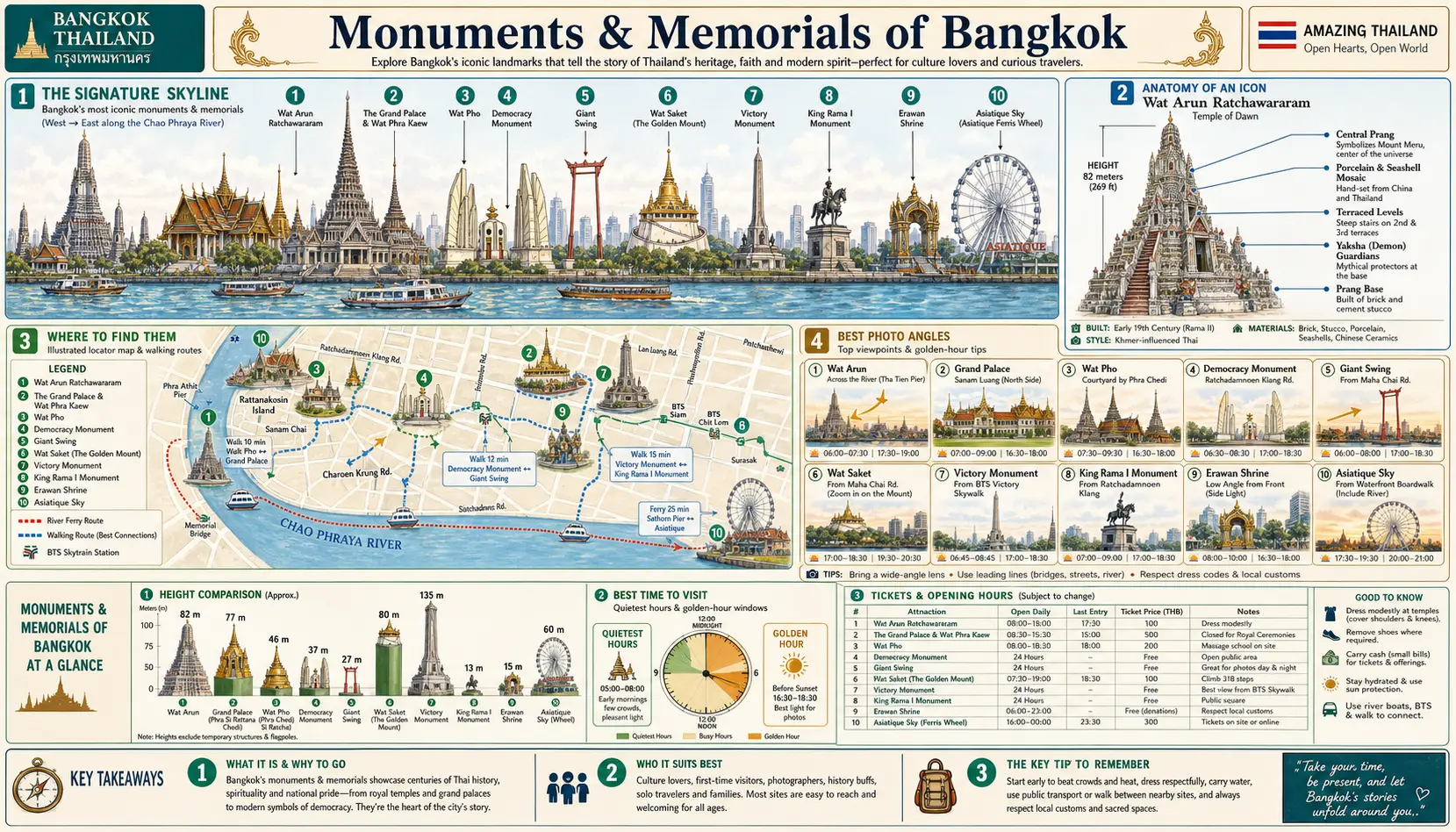
Democracy Monument sits marooned in the middle of Ratchadamnoen Klang, four concrete wings rising 24 metres for the 24th of June 1932, the day absolute monarchy ended. It was shaped with the Italian sculptor Corrado Feroci, who took Thai citizenship as Silpa Bhirasri and went on to define much of the country's public art. Bangkok's monuments are mostly twentieth-century and mostly political, planted on boulevards and traffic circles rather than in quiet squares, so seeing them means reading a city that argues with itself in concrete.
The main sites
Ratchadamnoen Klang is the spine: Democracy Monument at its centre, and the October 14 Memorial a short walk east at Khok Wua junction, marking the 1973 student uprising. Victory Monument, a 1941 obelisk raised after a brief border war with French Indochina, now functions mainly as a bus interchange beneath the BTS station of the same name. In Dusit, the bronze equestrian statue of King Chulalongkorn faces down the Royal Plaza towards the Italianate Ananta Samakhom Throne Hall. Across the river, King Taksin rides a horse in the middle of the Wongwian Yai roundabout, near the old Mahachai railway terminus.
Getting around them
None of the Rattanakosin monuments has a station on its doorstep. MRT Sam Yot on the Blue Line is the closest approach to Democracy Monument, roughly a fifteen-minute walk, and the Chao Phraya express boat to Phra Athit pier works well coming from the river. Victory Monument is the exception, sitting directly under its own BTS station. Dusit and the Royal Plaza still need a taxi or a bus. Go early, because these are open plazas with almost no shade, traffic circles them constantly, and the light is far kinder before nine. Nang Loeng market makes a good breakfast stop en route.