Waterfalls in Kyoto
A visual guide from the Kyoto travel guide — see all posters in Visual Guides.
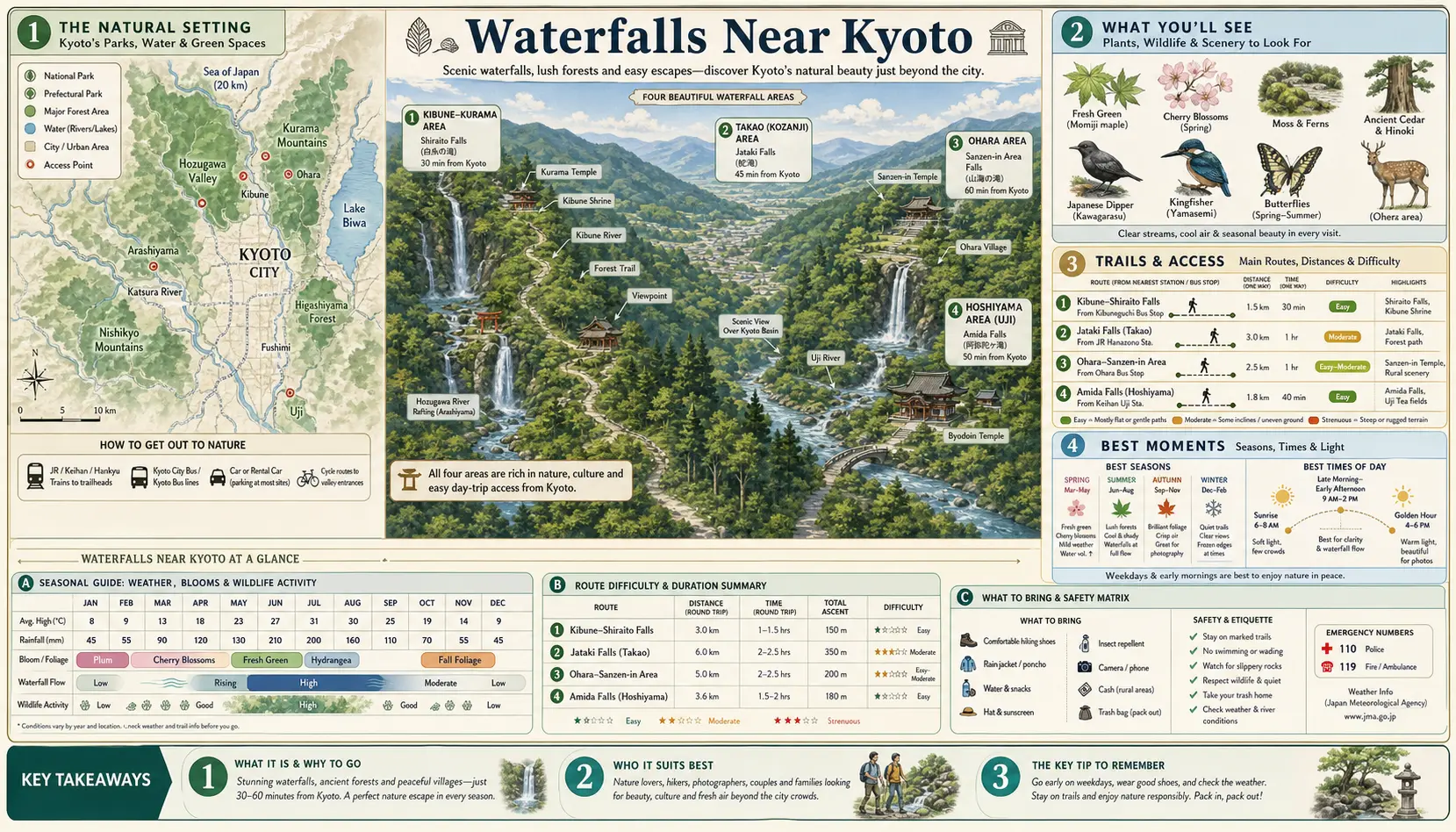
The waterfall most visitors meet in Kyoto is the smallest, three thin channelled streams at Otowa under the wooden stage at Kiyomizu-dera, with a queue and long-handled cups. The real ones are a bus ride further out, in the cedar gorges west and north of the city. Kuya Falls drops through a cleft above the Kiyotaki river, Otonashi runs at the head of Ohara's terraced valley, and the Kiyotaki gorge itself strings pools and cascades along a river path. They run hardest from the June rains through September and can thin to a trickle in a dry February.
Close to the city
Otowa Falls at Kiyomizu-dera is a five-minute stop rather than a destination, but worth timing for early morning when the queue is short. For something that feels genuinely remote, take a bus towards Kiyotaki, west of Arashiyama, and walk in: Kuya Falls is roughly a thirty to forty minute climb from the village, a slim drop of about a dozen metres into a cold, mossy hollow still used for cold-water training. From the same village, the Kiyotaki river path down to Hozukyo is two to three hours of pools, boulders and shade, and it finishes conveniently at a JR station.
Further out, and when to go
Above Ohara, roughly fifteen minutes' walk beyond Sanzen-in, Otonashi Falls sits at the top of the valley and makes an easy add-on to a day already spent among the terraced fields. In the far north of Kyoto Prefecture, near Amanohashidate and about two hours away by train, Kanabiki Falls is the region's most substantial, a wide curtain of around forty metres, a short drive or a half-hour walk from Miyazu station. Aim for June to September when flow is strongest, check for trail closures after typhoons, and treat the summer kawadoko platforms at Kibune as the lazy version of the same idea.