Old Quarter in Kyoto
A visual guide from the Kyoto travel guide — see all posters in Visual Guides.
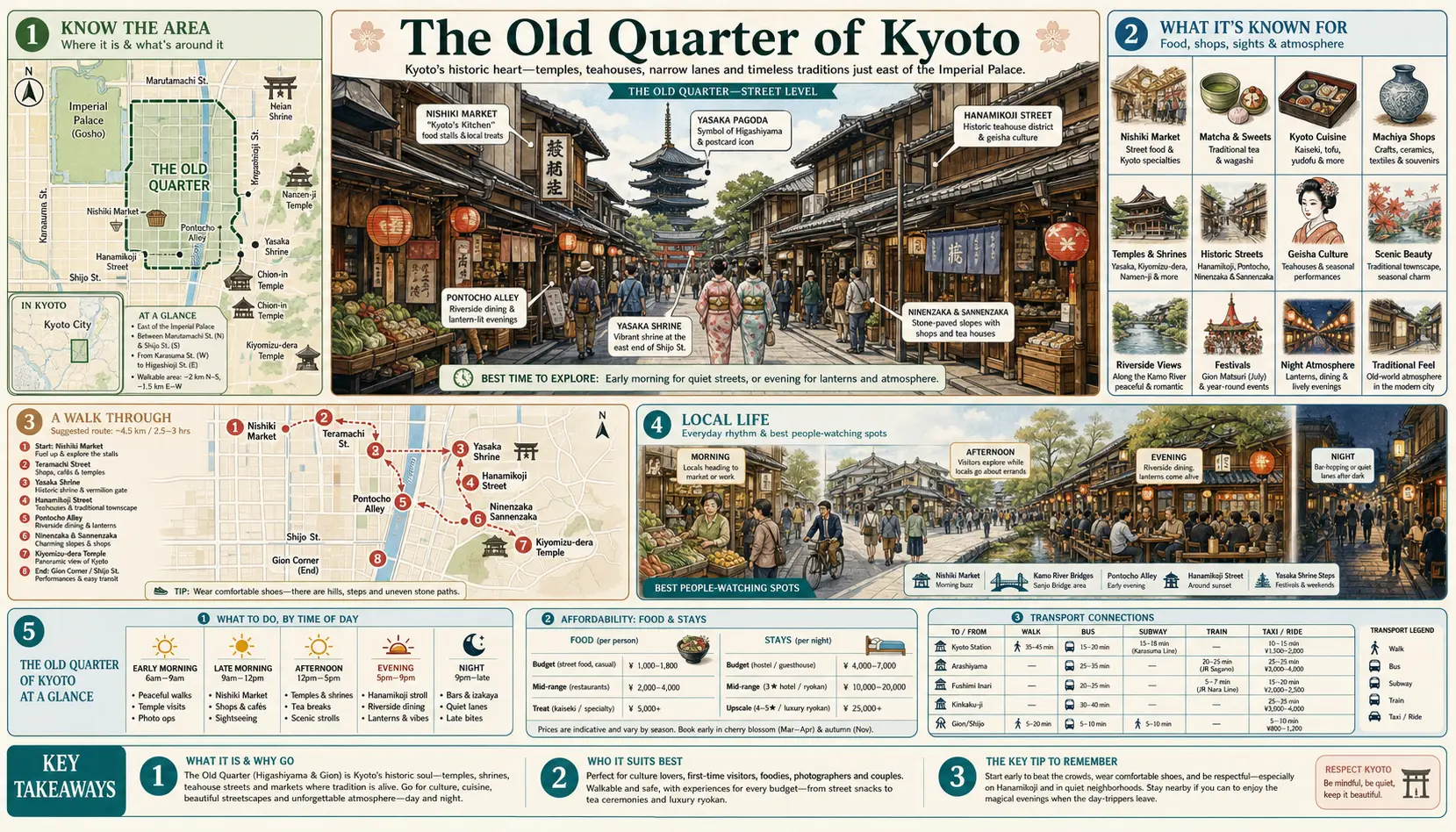
The stone stairs of Ninenzaka at seven in the morning are one of the few times Kyoto looks the way the postcards claim: wet grey flagstones, shuttered sweet shops, a cat, and the pagoda of Hokanji standing at the end of the slope with nobody in front of it. Two hours later the same 300 metres carry a slow-moving crowd. Kyoto's old quarters are small, tightly bounded and genuinely lived in — wooden machiya townhouses with lattice fronts, canal lanes, and working teahouse districts where residents are not exhibits.
The quarters worth walking
Southern Higashiyama is the headline route: Yasaka Shrine's gate, Maruyama Park, then Ishibei-koji — a short, walled, almost theatrically perfect lane — down Nenenomichi to Sannenzaka and Ninenzaka. Gion proper splits either side of Shijo: Hanamikoji running south past ochaya teahouses, and the Shirakawa canal lane to the north, willows over water, which is the prettier half and far less busy. Miyagawacho and Pontocho are narrower working districts. West of the centre, Nishijin keeps the weaving trade and rows of unrestored machiya with almost no visitors at all, reachable by the Karasuma subway to Imadegawa and a ten-minute walk.
Timing and etiquette
Early is everything. Between roughly seven and nine the lanes are empty, shutters are still down and the light on the stone is better; the same walk after ten is a queue. Gion's residents' association has posted no-photography rules on the private side streets off Hanamikoji, with signage warning of fines, and stopping geiko or maiko for pictures is off-limits — the streets are fair game, the people are not. Access is easy: Keihan to Gion-Shijo, the Tozai subway to Higashiyama, or city buses 100 and 206 up Higashioji. Allow two to three hours for the Higashiyama stretch at a walking pace.