Downtown Core in Kyoto
A visual guide from the Kyoto travel guide — see all posters in Visual Guides.
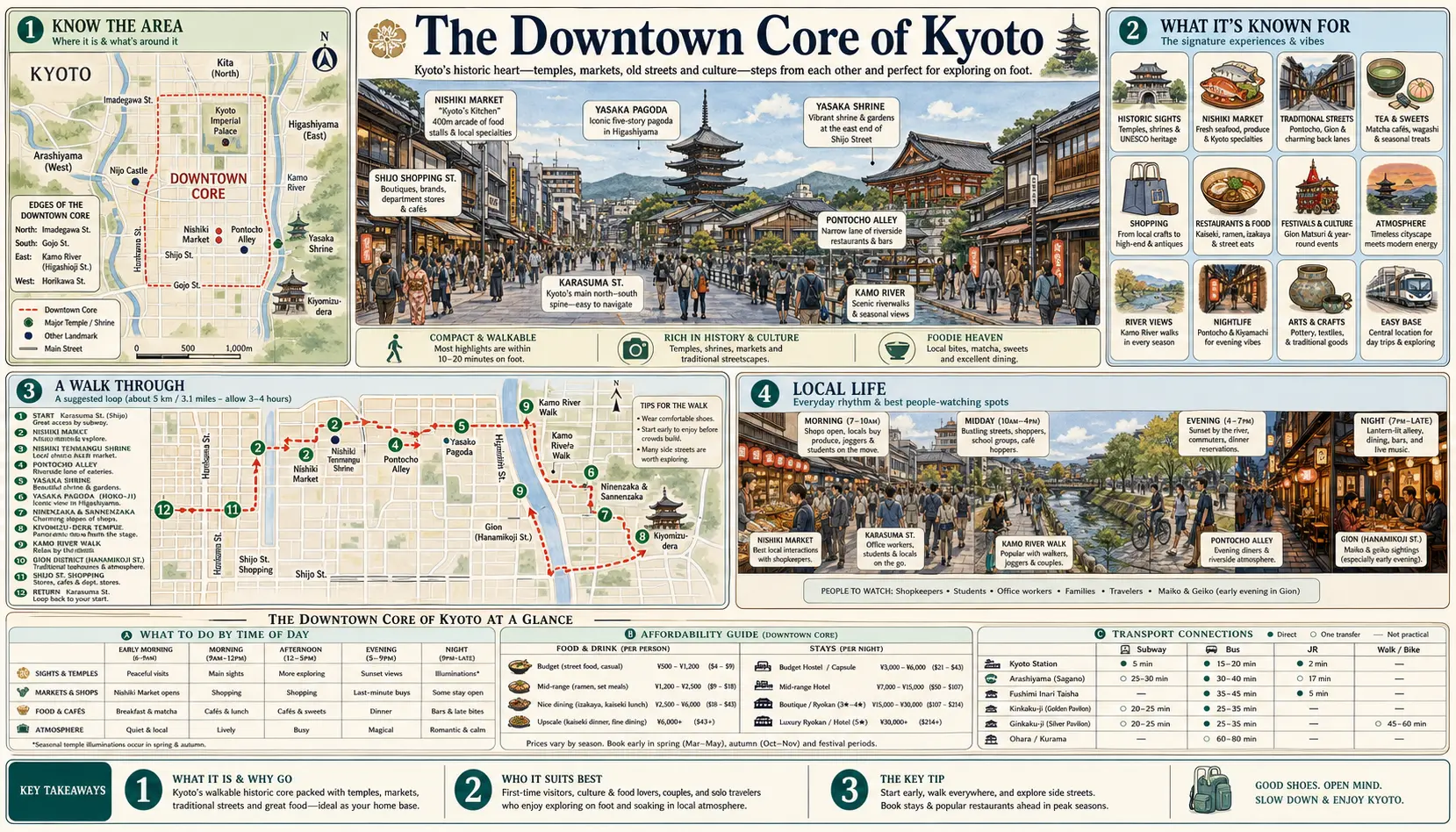
Kyoto's downtown is a rectangle you can cross in fifteen minutes, bounded by Shijo, Oike, Karasuma and the Kamo River. Shijo-Kawaramachi is the pivot, with two department stores facing each other, Hankyu trains terminating underneath and a river of people crossing on the diagonal. One block north is Nishiki Market; one block east, Pontocho narrows to a lantern-lit alley barely wide enough for two; and along the Takase canal, Kiyamachi turns into the city's drinking street after dark.
The grid, block by block
Shijo-dori is the retail spine, with Daimaru and Takashimaya facing off, the latter now linked to a shopping complex that includes a large Nintendo store, plus Fujii Daimaru for younger labels. Teramachi and Shinkyogoku run north from Shijo as parallel covered arcades, cheap and busy. Sanjo-dori west of Kawaramachi is the architecture street: the 1906 former Bank of Japan branch, now the Museum of Kyoto Annex, the brick Nakagyo Post Office and the 1928 Building. Karasuma-Oike is the office end, with Shinpuhkan and the Ace Hotel inside a 1926 telephone exchange.
Getting there and after dark
Four rail systems reach the area: Hankyu terminates at Kyoto-kawaramachi beneath Shijo, Keihan runs along the far bank through Gion-Shijo and Sanjo, and the two subway lines cross at Karasuma-Oike. Kyoto Station sits two kilometres south and feels like a different city, four minutes down the Karasuma line from Shijo. In the evening, Pontocho does small kappo counters, and from May to September restaurants build wooden platforms out over the Kamo River. Kiyamachi is louder and cheaper. The riverbank itself is free, and on warm nights people sit along it in an even line.