Best Markets and Bazaars in Kyoto
A visual guide from the Kyoto travel guide — see all posters in Visual Guides.
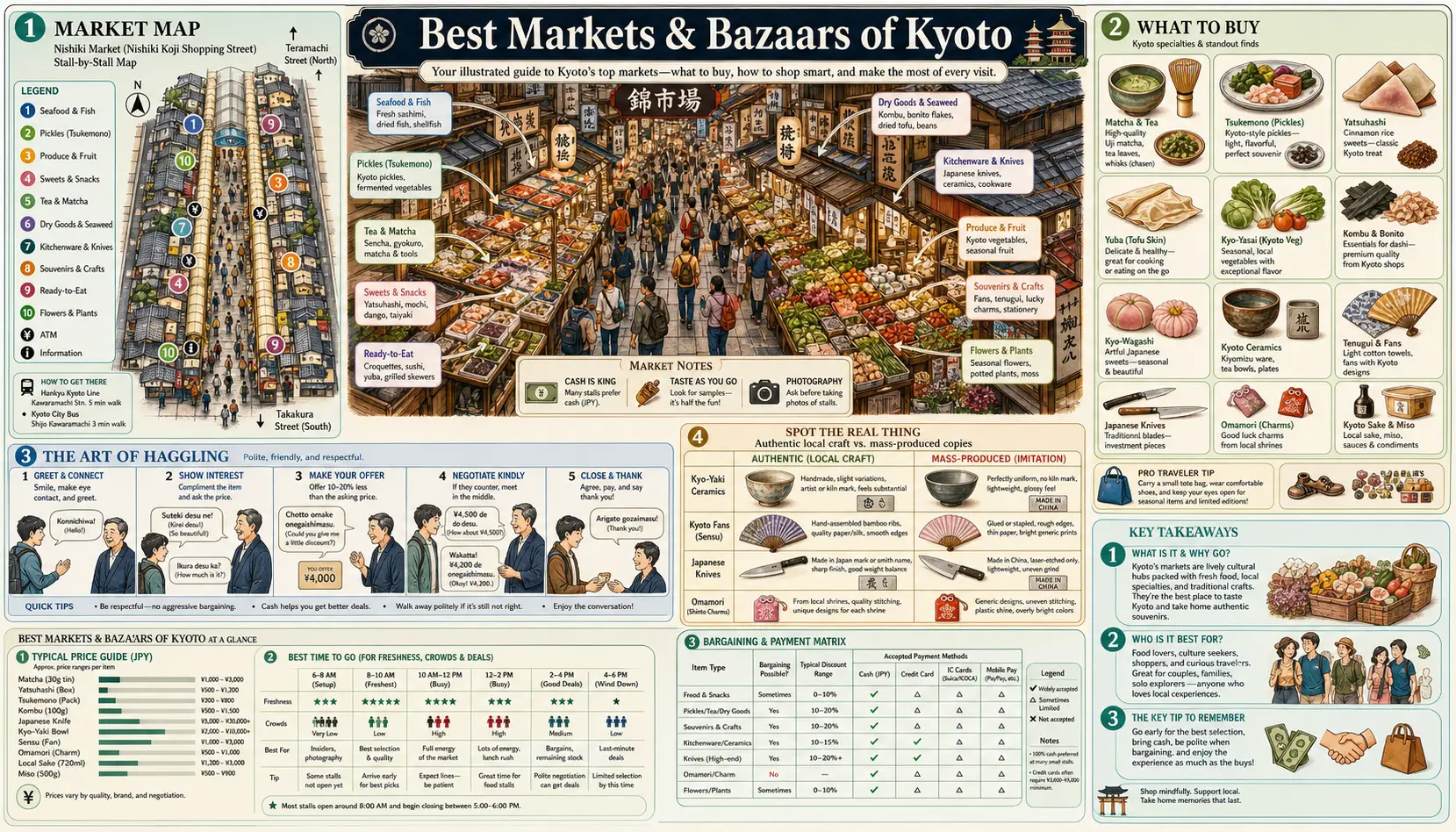
Kyoto's biggest markets run on a calendar rather than a weekend. On the twenty-first of every month more than a thousand stalls fill the grounds at To-ji, selling old kimono by the kilo, carpenters' tools, blue-and-white china, bonsai and fried food; on the twenty-fifth the same crowd shifts across town to Kitano Tenmangu. Traders start setting up before dawn, the good textiles go early, and by mid-afternoon the tarpaulins are coming down. Cash, a tote bag and an early alarm are the whole strategy.
The monthly fixtures
Kobo-san at To-ji on the twenty-first is the largest and most varied, with antiques and junk side by side and a solid row of food stalls. Tenjin-san at Kitano Tenmangu on the twenty-fifth leans further towards antiques, vintage textiles and ceramics, and feels marginally calmer. The Chion-ji handmade market at Hyakumanben, usually the fifteenth, is different in character: several hundred makers selling their own ceramics, prints and leatherwork to a Kyoto University crowd. All three are outdoors and go ahead in light rain, though heavy rain thins the stalls considerably.
Shopping the arcades
Between market days, Teramachi-dori between Sanjo and Nijo is the old-trade street, with incense at Kyukyodo on the Anekoji corner, tea at Ippodo up at Nijo, secondhand bookshops and scroll dealers all inside a few hundred metres. South of Sanjo, Teramachi and Shinkyogoku turn into covered youth arcades full of vintage clothing, sneakers, game centres and cheap food. Shinmonzen in Gion is the serious antiques street, where dealers handle screens and lacquer at prices to match. For a large indoor fair, the Kyoto Antique Fair at Pulse Plaza in Fushimi typically runs a few times a year over three days.