War and Resistance History in Bangkok
A visual guide from the Bangkok travel guide — see all posters in Visual Guides.
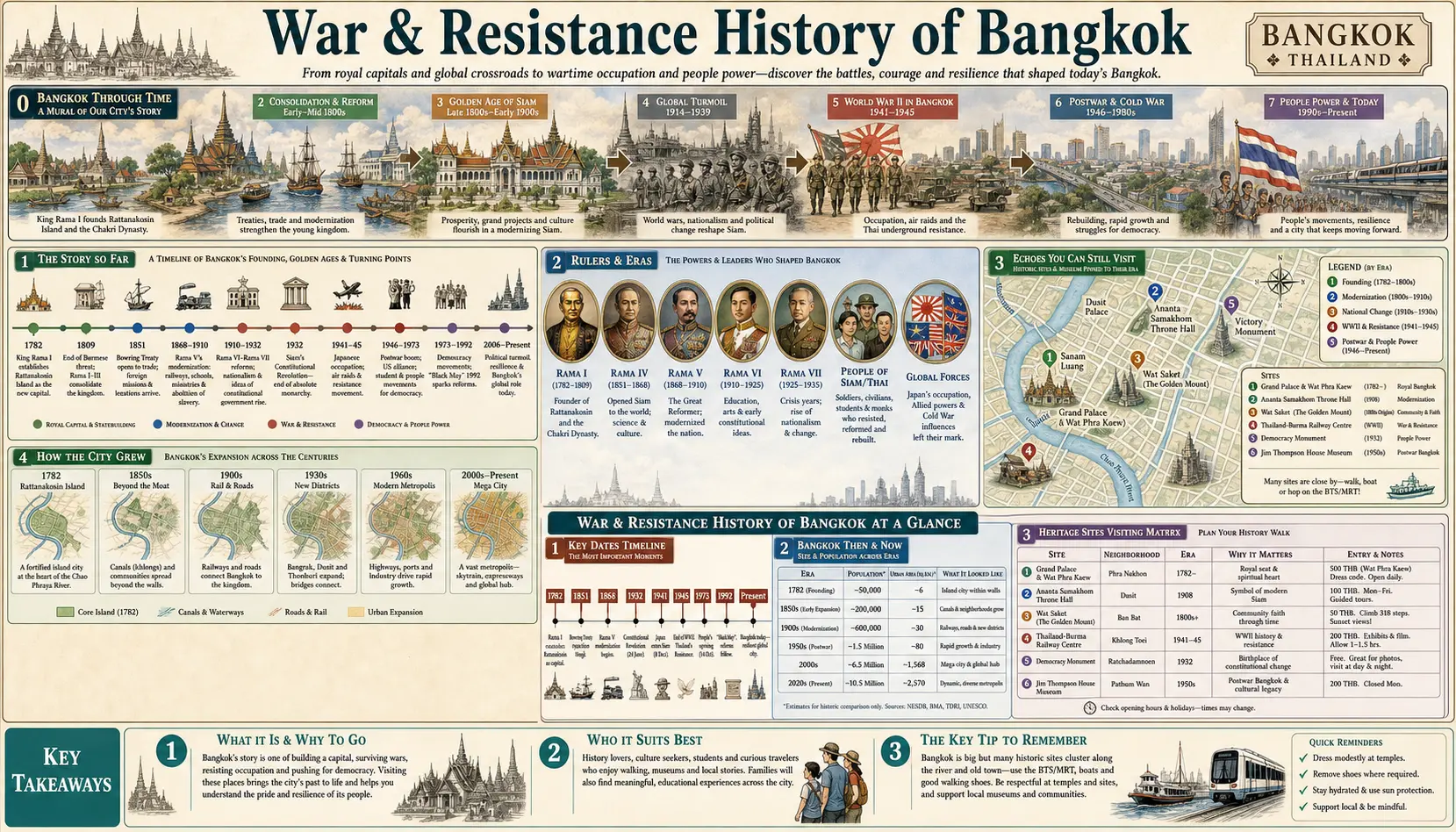
Bangkok wears its twentieth-century history lightly, folded into the rush of BTS trains and glass towers rather than roped off in solemn halls. Traces of the city's WWII years and its clandestine resistance movement survive in a handful of landmarks and museums, best explored as a change of pace between rooftop bars and riverside malls. It is a story of occupation, quiet defiance, and a fiercely modern capital that rebuilt itself around the memory.
Victory Monument: history inside a traffic circle
The obelisk at Anusawari Chai Samoraphum, or Victory Monument, commemorates Thailand's brief 1940-41 conflict with French Indochina. Today it is better known as one of Bangkok's busiest BTS interchanges, ringed by budget malls, street-food stalls, and late-night minivan stands. Locals rarely pause to read the inscriptions — the monument has simply become part of the city's traffic-and-transit rhythm, a reminder that Bangkok tends to absorb its past into daily life rather than freeze it behind glass.
The Seri Thai story
During World War II, Japan occupied Thailand and used Bangkok as a logistics base, while a clandestine network known as the Seri Thai (Free Thai Movement) worked with the Allies from within the capital and abroad. Operatives moved through the same riverside districts and old-town lanes that visitors now wander between cafés and design shops. Little physical signage marks their work, but the movement's legacy shaped Thailand's postwar standing as the only Southeast Asian nation to avoid formal colonization or occupation-era collapse.
Military museums for a deeper look
For visitors who want specifics rather than atmosphere, Bangkok's military museums fill the gaps. The Royal Thai Armed Forces collections and smaller ordnance and aviation displays trace the kingdom's twentieth-century conflicts, uniforms, and hardware in more traditional exhibit form. They are quiet, air-conditioned counterpoints to the Victory Monument's chaos, and pair well with a wider day of modern Bangkok — a skywalk coffee stop, a mall food court, or a sunset river cruise afterward.
A city that moved forward
What stands out in Bangkok is less the preserved battlefield than the skyline built on top of it. The BTS line arcs directly over Victory Monument; condos and co-working spaces now occupy blocks that once sheltered wartime intrigue. That layering is the real story — a capital that treats its resistance history as one thread in a much bigger, forward-looking fabric, rather than the whole tapestry, and invites travelers to notice it only if they choose to look down from the train.