Civic Landmarks and Clock Towers in Bangkok
A visual guide from the Bangkok travel guide — see all posters in Visual Guides.
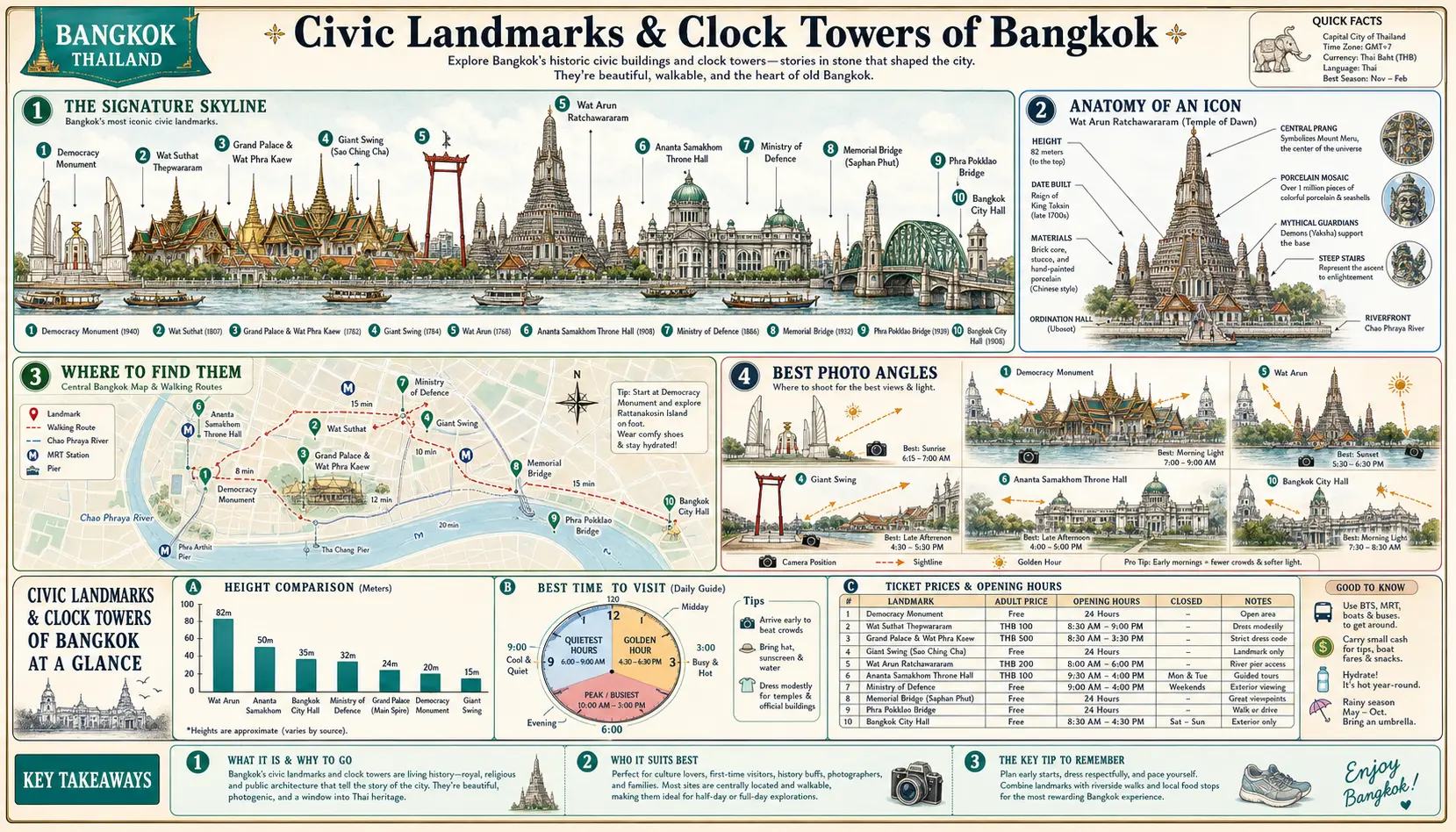
Bangkok rarely gets credit for its civic architecture, overshadowed as it is by rooftop bars and glass towers, but the city's traffic circles and public squares hold some of its most photogenic monuments. Democracy Monument and Victory Monument anchor major roundabouts with Art Deco-meets-nationalist styling, while the old Hua Lamphong railway hall still wears its landmark clock face proudly. Together they map out a century of civic ambition, best explored on foot or from the elevated BTS platforms above.
Democracy Monument and the Ratchadamnoen Axis
Built in 1939, Democracy Monument sits at the center of a broad boulevard modeled loosely on European ceremonial avenues, its four wings and central turret commemorating Thailand's constitutional era. It's a striking piece of civic sculpture day or night, especially when lit up and framed by passing traffic. The surrounding Ratchadamnoen corridor has seen recent restoration, with wider footpaths and cafe-lined blocks making it far more walkable than it once was, and a good starting point before heading toward the river or the old town's boutique art spaces.
Victory Monument's Modern Traffic Circle
Victory Monument, a soaring obelisk ringed by military figures, doubles as one of the city's busiest interchange hubs, with a dedicated BTS station and a warren of minivan stops radiating outward. It's less about lingering and more about experiencing Bangkok's relentless motion firsthand: skywalks loop pedestrians above the roundabout while street-food stalls and cheap noodle shops cluster at its base. At night the monument glows under floodlights against a backdrop of illuminated condo towers, a good snapshot of how the city layers old civic symbols beneath a very modern skyline.
Hua Lamphong's Landmark Clock Face
The grand vaulted hall of the old Hua Lamphong railway station, opened in 1916, remains one of Bangkok's most recognizable civic landmarks thanks to its curved Italian-influenced facade and the oversized clock set into its pediment. Even as high-speed rail operations have shifted to the newer Bang Sue Grand Station, Hua Lamphong's hall still draws visitors for its architecture and its role as a living transit museum. Arrive by MRT and step back to admire the clock and dome together, a genuinely elegant piece of early twentieth-century public engineering.
City Hall, BACC, and the Public-Space Boom
Bangkok's civic identity keeps evolving through newer public buildings: the curving glass form of the Bangkok Art and Culture Centre near National Stadium functions as an informal town square for exhibitions and events, while Bangkok City Hall anchors the old administrative quarter with a more traditional government facade. Add in expanding riverside promenades and elevated parks threading beneath expressways, and it's clear the city is investing in shared civic space again, blending function with genuinely photogenic modern design.