Getting Around Kyoto: Transport Guide
A visual guide from the Kyoto travel guide — see all posters in Visual Guides.
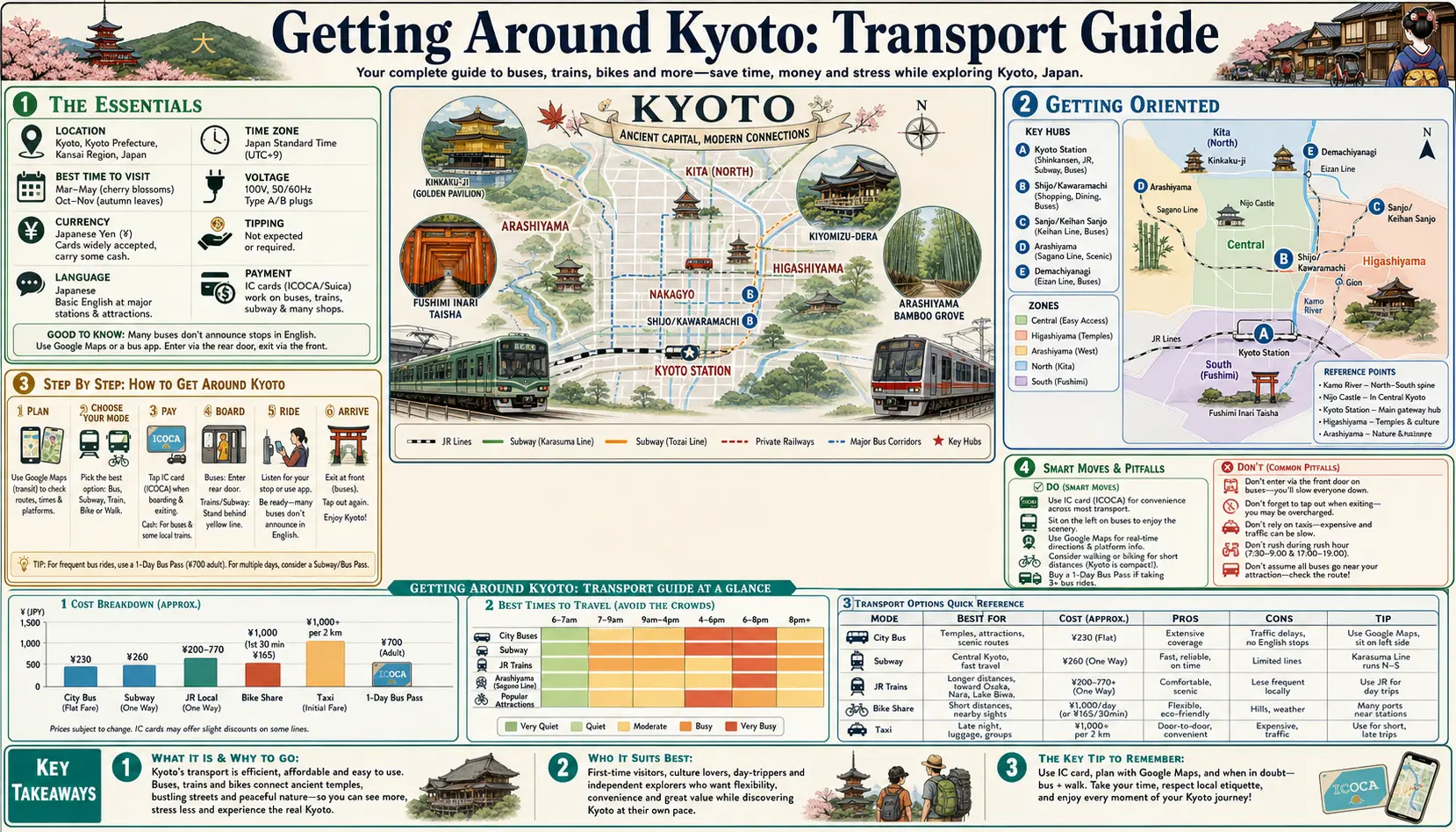
Kyoto is refreshingly easy to navigate once you know the pieces. A compact subway, a dense bus network, JR trains, and a charming little tram cover almost everything, and a single tap-and-go IC card works across nearly all of them. The city is also famously flat and bike-friendly. With a bit of planning you can skip the traffic entirely and glide between neighbourhoods, gardens, and the futuristic station hub at the city's heart.
Trains, Subway & Tram
Kyoto's rail backbone is simple: two subway lines cross at Karasuma-Oike and cover the central spine fast, while JR lines fan out from the giant Kyoto Station to Arashiyama, Nara, and beyond. For the west side, the vintage Randen tram trundles scenically toward the bamboo groves. Trains are punctual, clean, and easy to read with English signage. For longer hops and day trips, rail is almost always faster and comfier than the road.
Buses & IC Cards
Because many sights sit away from the subway, the city bus network fills the gaps and reaches nearly everywhere. Boards are numbered and signed in English, and buses can get busy at peak times, so allow a little extra. The key to painless travel is a rechargeable IC card (ICOCA, Suica, and the like): tap on and off buses, subways, and trains without buying individual tickets. Grab one at any station machine on arrival and top it up as you go.
Cycling & On Foot
Kyoto is one of Japan's best cities to explore by bicycle. It's flat, gridded, and dotted with rental shops and share stations, and pedalling along the Kamo River or between neighbourhoods is genuinely one of the nicest ways to see the place. Many districts are also a pleasure on foot, with walkable lanes and riverside paths. Mix a rail pass for the long distances with a bike or your own two feet for the last mile, and you'll move like a local.