Civic Landmarks and Clock Towers in Kyoto
A visual guide from the Kyoto travel guide — see all posters in Visual Guides.
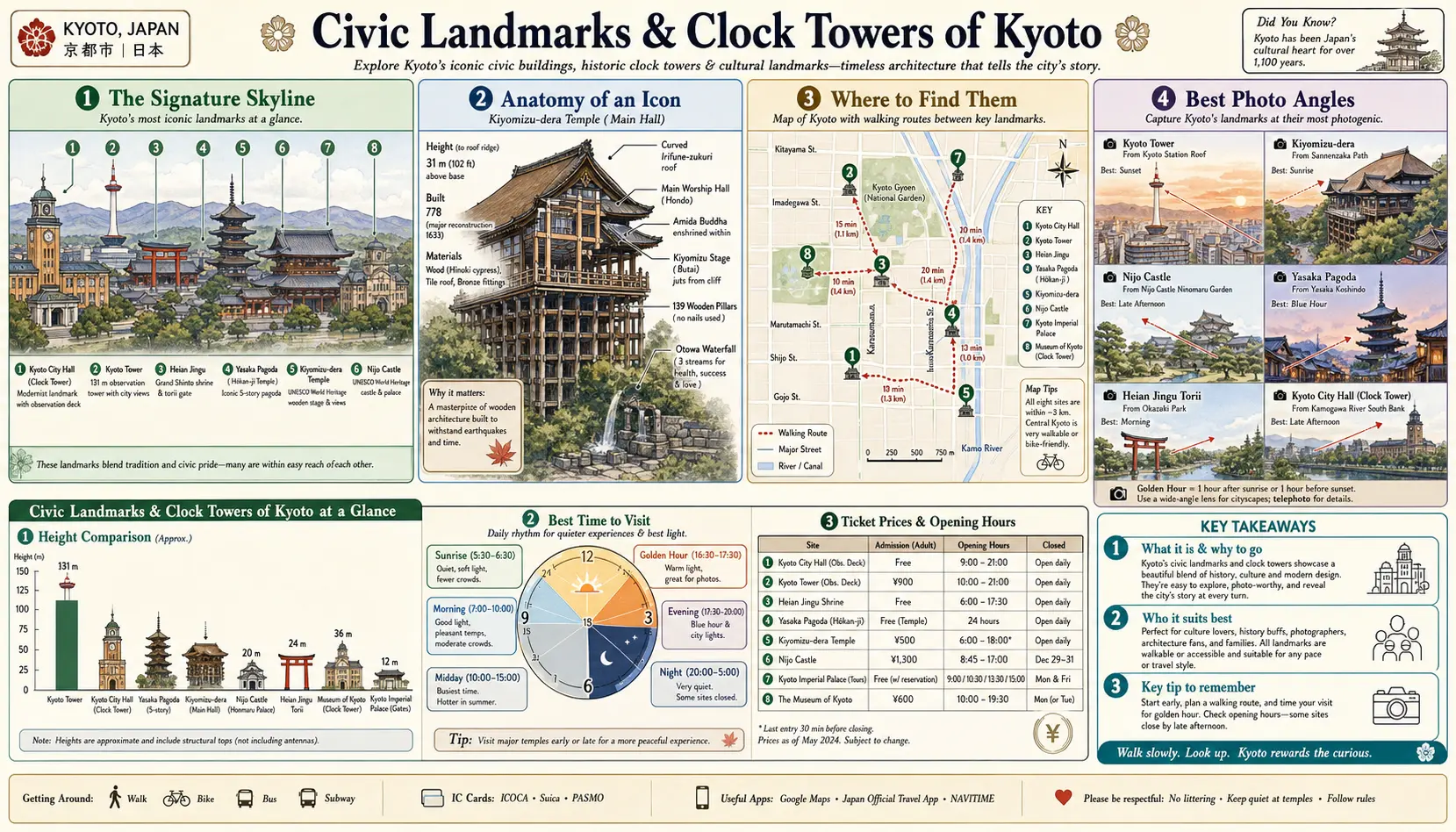
Kyoto is famous for its historic streets, but its civic architecture tells a different story: a city that modernized boldly. Kyoto Station's soaring glass atrium, the needle-like Kyoto Tower, and a handful of mid-century municipal buildings show a place unafraid to mix eras. This is the Kyoto of escalators and observation decks as much as gardens & alleys, and it rewards a slow, curious walk just as much as any historic quarter.
Kyoto Station's Modern Cathedral of Glass
Few transit hubs in Japan feel as architecturally ambitious as Kyoto Station. Completed in 1997, its cavernous steel-and-glass atrium rises fifteen stories, stacking a hotel, department store, theater, and a rooftop terrace into one dramatic civic space. A wide staircase doubles as public seating and an event venue, especially during winter illuminations. Ride the escalators to the top for a free, sweeping view over the city's rooftops toward the surrounding hills — one of the best free viewpoints in Kyoto, and a natural orientation stop right where most visitors arrive.
Kyoto Tower's Retro-Futurist Silhouette
Rising just across from the station, Kyoto Tower has topped the skyline since 1964, its slender white spire designed to evoke a candle or lighthouse guiding travelers. It remains the city's tallest structure, and its observation deck offers panoramic views unmatched elsewhere downtown — especially at dusk, when the basin fills with lights and the hills fade to silhouette. Purists once grumbled about a tower interrupting Kyoto's low-rise skyline, but decades on it's simply part of the view, a bold mid-century landmark in a city layered with eras.
Civic Buildings and a Repurposed Schoolhouse
Kyoto's municipal architecture rewards a wander beyond the station. The Kyoto International Manga Museum occupies a handsome 1920s former elementary school, its wooden corridors and stairwells preserved alongside modern gallery space — a nice example of civic reuse. Nearby, Kyoto City Hall and the Kyoto International Conference Center, a striking trapezoidal 1966 design set beside a lake in the northern hills, show how the city paired postwar optimism with restrained, distinctly Japanese modernism.
Getting Around and Making a Loop
These landmarks cluster conveniently: start at Kyoto Station, ride up for the skyline view, then cross to Kyoto Tower before the light turns golden. Kyoto's compact bus and subway network makes it easy to loop in the Manga Museum or a City Hall stroll afterward, and the station's food floors and department store are a reliable spot to refuel. Pair the walk with dinner in the surrounding downtown grid, where modern bars and izakaya sit comfortably beside decades-old shopfronts.