Photography Hotspots in Siem Reap & Angkor Wat
A visual guide from the Siem Reap and Angkor Wat travel guide — see all posters in Visual Guides.
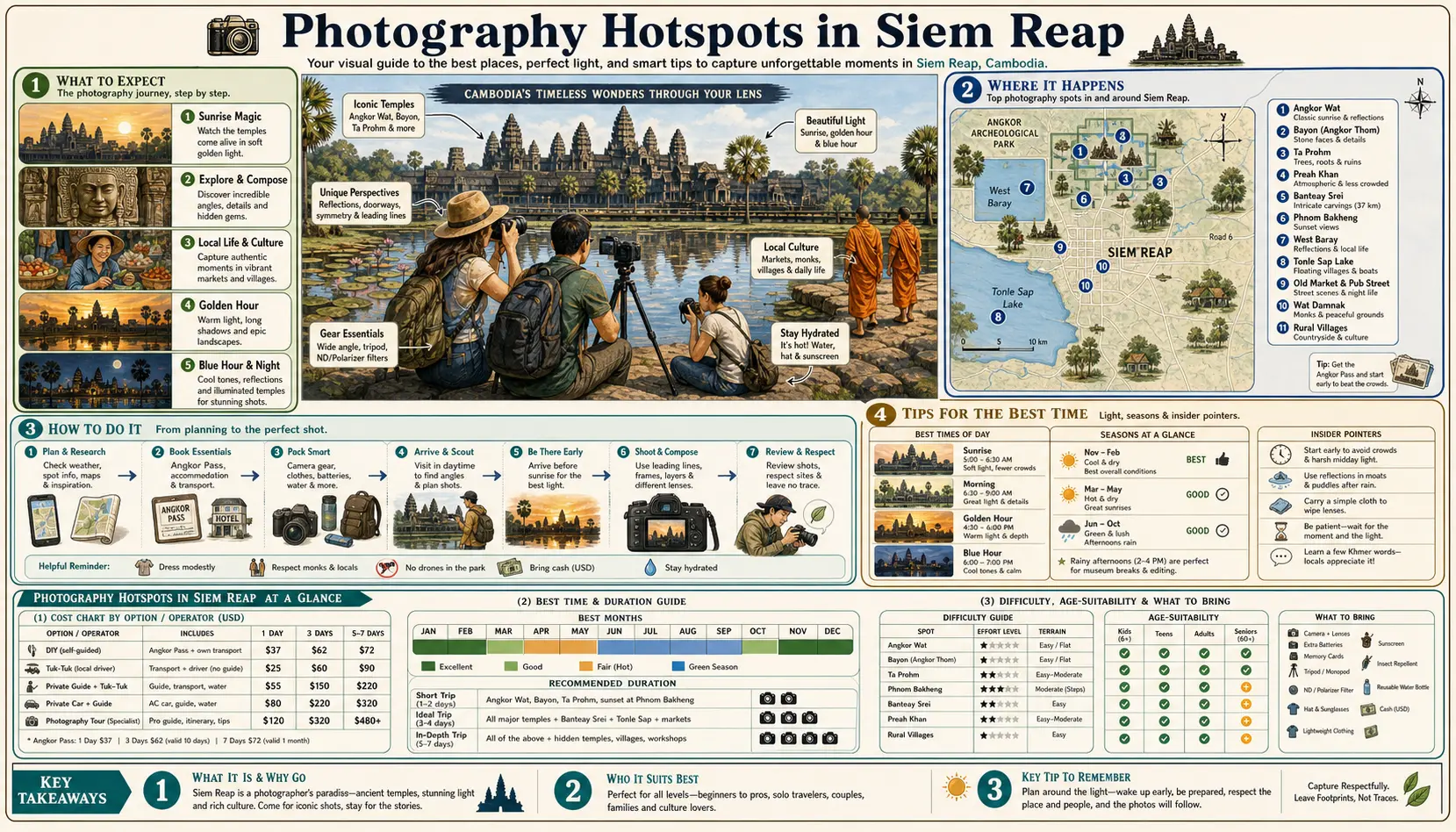
The famous frame — five towers doubled in a lily pond — comes from the left-hand pond as you walk in, and by quarter past five in December that bank is already several rows deep. It is still worth the alarm: the sky goes orange behind the silhouette a good half hour before the sun clears the towers, and most of the crowd leaves the moment it does, which is exactly when the light starts working on the stone. Almost everything else in the park rewards the same logic.
The reliable spots
Angkor Wat's north pond for sunrise; the Bayon between roughly 08:00 and 09:30, when low side light picks out the face towers and the crowded bas-reliefs of the outer gallery; Ta Prohm as early as you can manage, before the walkways fill, and better still in rain when the roots go black. Preah Khan's long collapsing corridors and its odd two-storey round-columned building give the best interiors in the park. For sunset, Pre Rup's brick terraces look west over palm and paddy, while Srah Srang's landing stage is the quiet alternative at dawn. Phnom Bakheng caps numbers at the top, so queues build from mid-afternoon.
Practicalities
Drones are not permitted over the Angkor park without authority permission, and this is enforced. A wide lens does most of the work; a mid-telephoto earns its place on the devata carvings and the Bayon faces. The hazards are laterite dust off the park roads and the fog that hits cold glass the moment you step out of an air-conditioned car, so change lenses sparingly. Beyond the temples, the stilt villages at Kampong Phluk and Kampong Khleang photograph best in late afternoon as the boats come in, the Road 60 night market gives the best colour in town after dark, and the fruit bats over the Royal Independence Gardens lift off at dusk.