Colonial Era Heritage in Siem Reap & Angkor Wat
A visual guide from the Siem Reap and Angkor Wat travel guide — see all posters in Visual Guides.
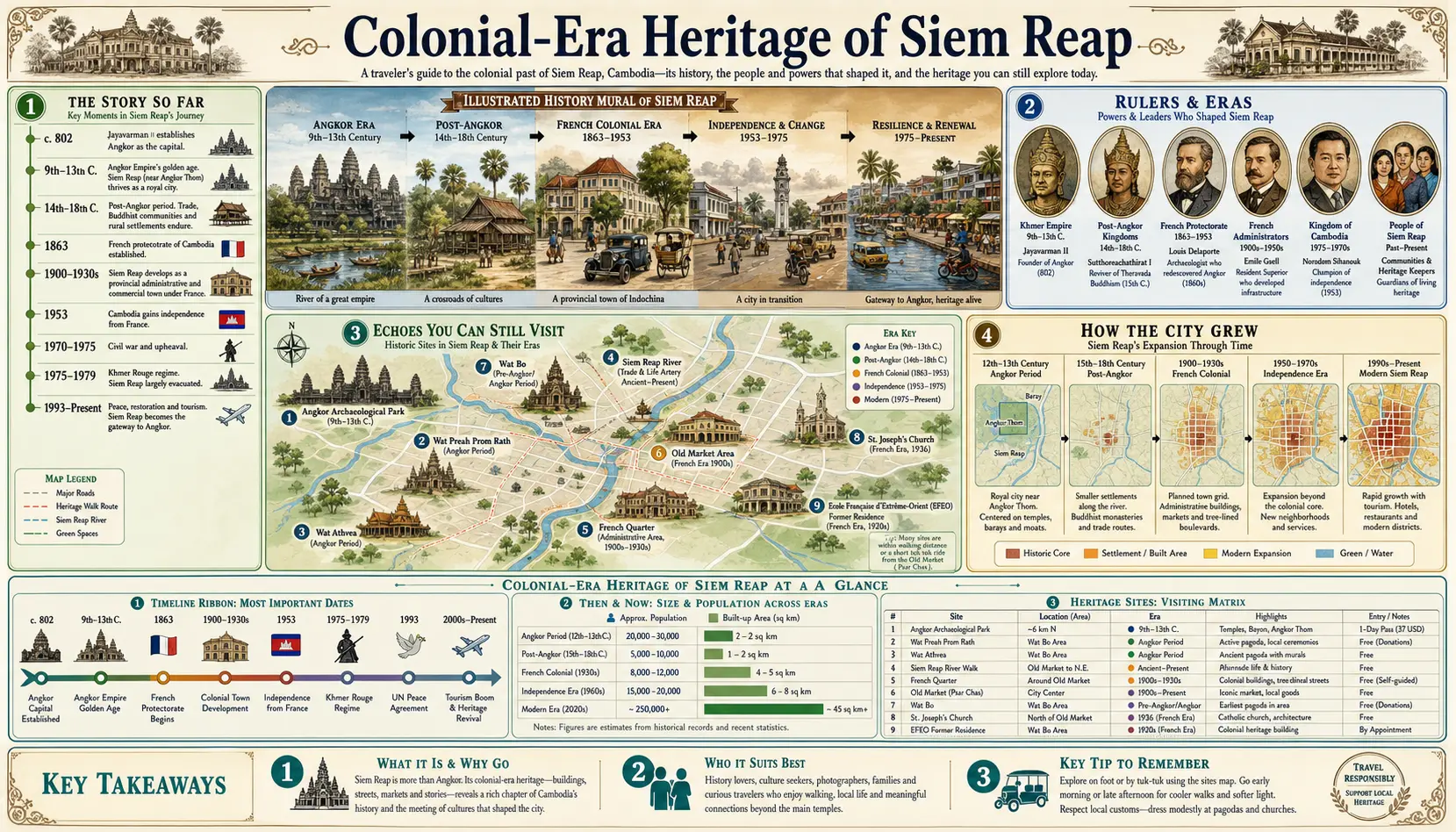
Siem Reap grew into a town because of Angkor. When the French protectorate took the temples into its care in the early 1900s and the first tourists began arriving by river and road, a small administrative settlement was laid out along the riverbank: shophouses around the market, villas for officials on the east side, and, in 1932, the Grand Hotel d'Angkor at the head of a long avenue. Much of that street plan survives, and the ochre-and-shutter architecture around Psar Chas is now the town's most photographed asset that is not a temple.
What to look at
Start at Psar Chas, the covered market building from the French period, then walk the shophouse rows on the streets immediately around it — arcaded ground floors, louvred shutters and tiled awnings, most now cafés and shops. Pokambor Avenue follows the river past the Royal Independence Gardens to Raffles Grand Hotel d'Angkor, opened in 1932 and still running its original cage lift. The east bank around Wat Bo holds the surviving official villas, low and deep-verandaed under old trees; FCC Angkor occupies one of them, usually described as the former French governor's residence. Add the 1960s hotels along Sivatha for the New Khmer Architecture that followed independence.
Doing the walk
The full circuit is about two kilometres and completely flat, best walked between 07:00 and 09:00 before the heat and the tuk-tuk traffic build, or after 17:00 when the shutters open again and the riverbank fills up. Cross at the footbridge near the Art Center Night Market to link the two banks without a detour. There is no formal heritage trail and very few plaques, so this is a looking-up exercise rather than a guided one, and a coffee under one of the arcades makes the natural halfway point. For the history properly framed, the Angkor National Museum on Charles de Gaulle Road covers the rediscovery era well.