Street Art and Murals in Penang
Part of the Penang travel guide — see every topic in All Penang Guides.
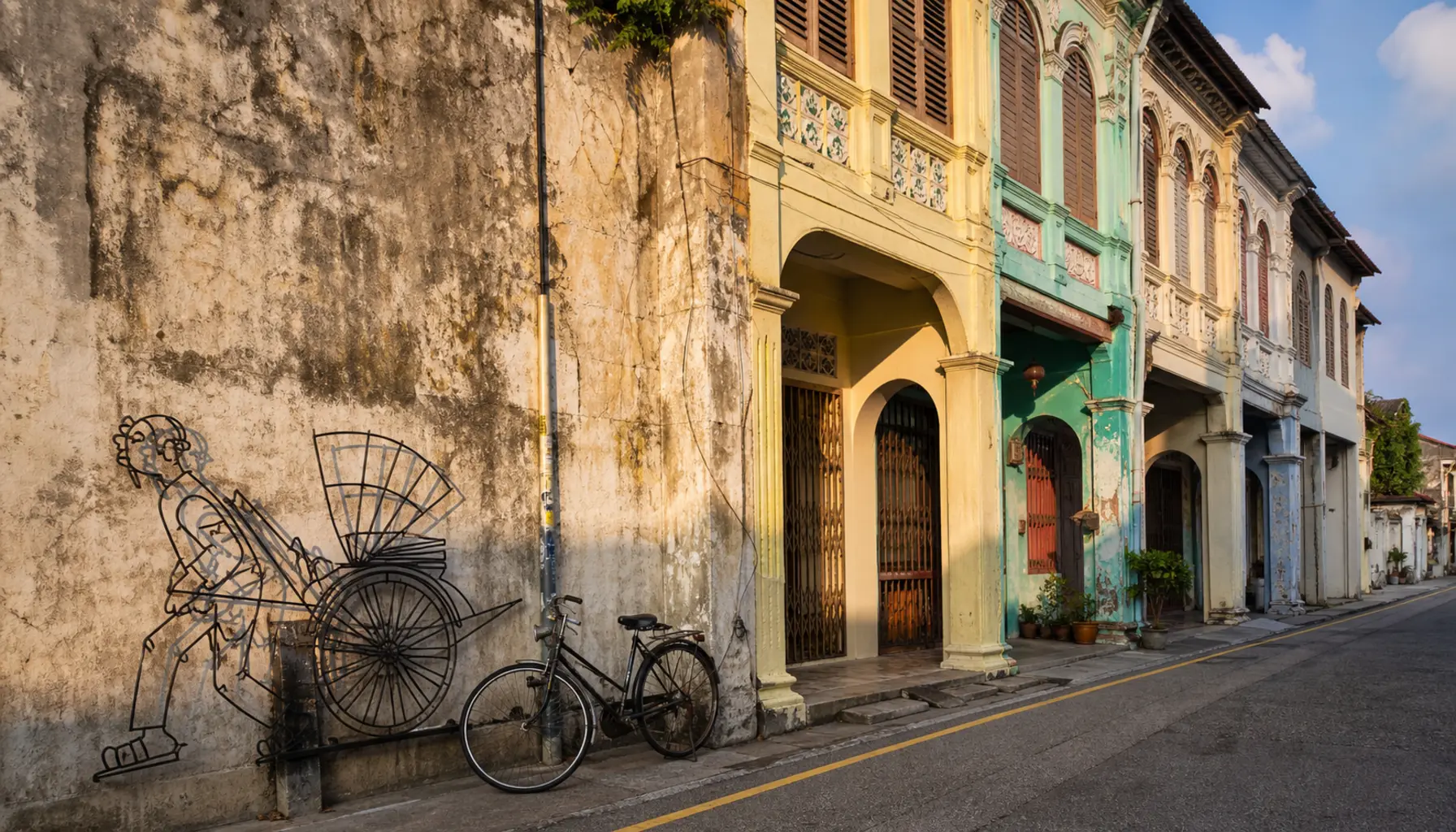
George Town's street art began as a commission. In 2012 the Lithuanian artist Ernest Zacharevic was invited to produce a series of murals for the George Town Festival, and the resulting works — children on a real bicycle, a boy on a real motorbike, figures interacting with the actual fabric of the shophouses — went around the world and changed the town's tourism overnight. What is often missed is that the wrought-iron caricature sculptures came first, in 2009, and that dozens of artists have added work since.
The Zacharevic murals
Six original works were painted in 2012 for the Mirrors George Town project. "Kids on Bicycle" on Lebuh Armenian is the famous one — two painted children leaning into a real bicycle bolted to the wall — and there is usually a queue to photograph it. "Boy on a Bike" on Lebuh Ah Quee uses a real motorcycle. "Little Children on a Swing" and the others are scattered through the core. Several have faded, been damaged or been retouched over the years, which is the nature of exterior paint in a monsoon climate.
The iron sculptures
Predating the murals, the Marking George Town project of 2009 installed fifty-two wrought-iron caricature sculptures around the historic core, each illustrating a story about the street it stands on: how Cannon Square got its name, why Love Lane is called that, what happened on Chulia Street. They are witty, well made and almost universally overlooked in favour of the paintings. Following them is a better way to learn the town's history than any plaque, and a map of all fifty-two is easy to find.
The rest of the scene
Since 2012 dozens of murals have been added by Malaysian and international artists, some commissioned, some not, ranging from large-scale portraits to small interventions in doorways and stairwells. Concentrations are along Lebuh Armenian, Lebuh Ah Quee, Lebuh Chulia, Lorong Muntri and Lebuh Pantai. Quality varies and some are frankly commercial — several cafes have commissioned murals to draw photographs. The works turn over: pieces fade, get painted over and are replaced, so a map more than two years old will be partly wrong.
Seeing it
It is a walk rather than a list: start on Lebuh Armenian, work through the lanes, and let the iron sculptures pull you into the side streets. Two hours covers the core. Go early — the famous murals have queues from mid-morning and the light is better before nine. Guided art walks cost 60–120 ringgit and are useful mainly for what has changed. Bicycle rental at 10–20 ringgit a day works well for the wider spread. And remember these are people's homes and shops, not a gallery.
Street Art and Murals at a glance
| The famous ones | Ernest Zacharevic, 2012, for the George Town Festival |
|---|---|
| Best known | "Kids on Bicycle", Lebuh Armenian — expect a queue |
| Came first | 52 wrought-iron caricature sculptures, 2009 |
| Densest streets | Armenian, Ah Quee, Chulia, Muntri, Pantai |
| Best time | Before 9am — queues and hard light after |
| Note | Works fade and are replaced — old maps go stale |