Street Food Guide in Kuala Lumpur
Part of the Kuala Lumpur travel guide — see every topic in All Kuala Lumpur Guides.
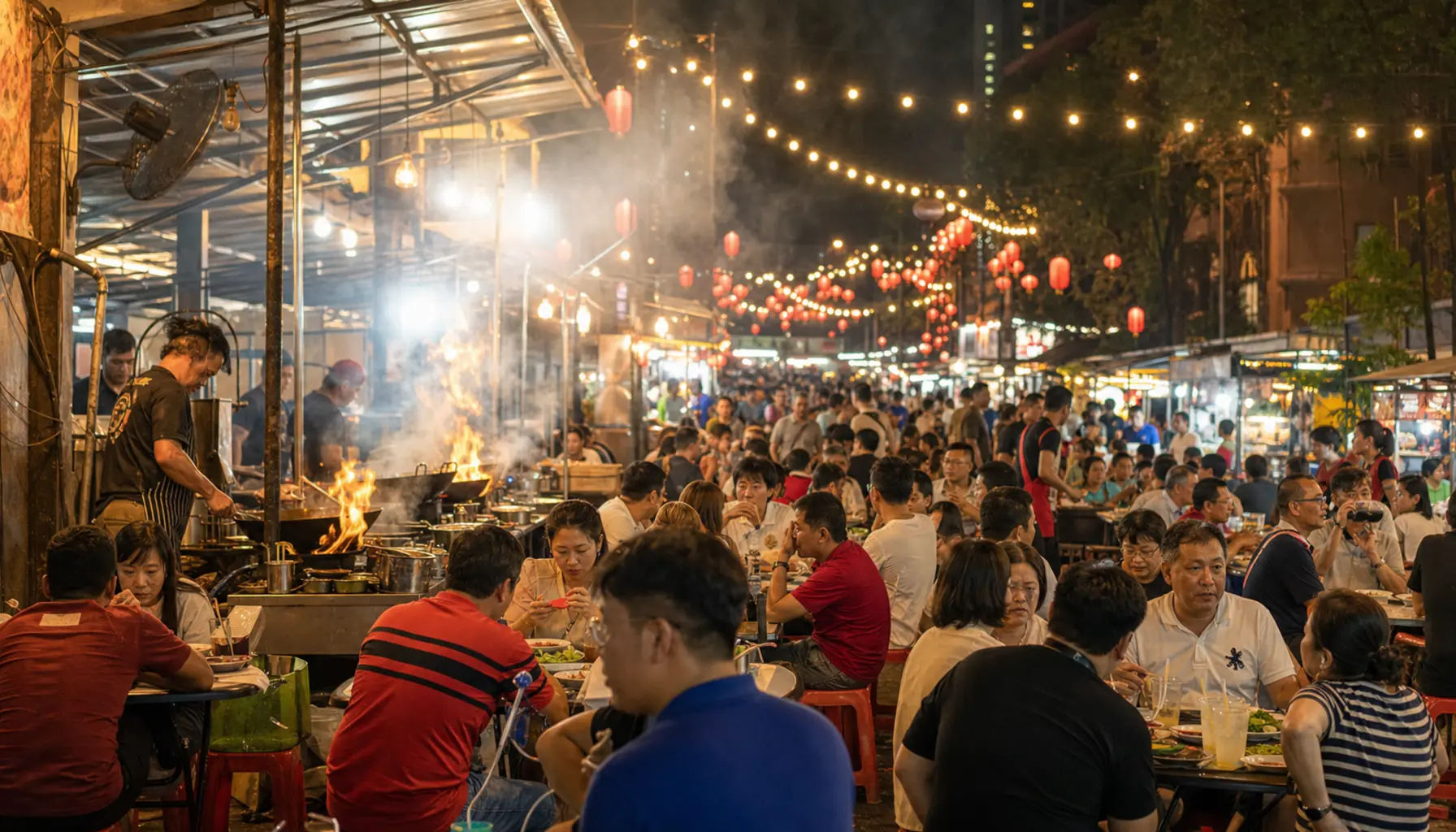
Kuala Lumpur's street food is the product of Malay, Chinese and Indian communities cooking side by side for a century and a half, frequently on the same street and increasingly in each other's styles. The formats are specific: the kopitiam, an old-fashioned coffee shop that rents out its stalls; the hawker centre or food court; the mamak, an Indian-Muslim open-air place that never closes; and the night market. Between them the city eats around the clock and a full meal costs 8–20 ringgit.
Jalan Alor and Bukit Bintang
Jalan Alor is the city's best-known food street: a single block behind Bukit Bintang that closes to traffic in the evening and fills with plastic tables, grills, seafood tanks and a hundred stalls. It is touristy, it is not the cheapest, and it is still genuinely good — the grilled chicken wings, satay, char kway teow and Thai-Chinese seafood are all reliable. Order from several stalls at one table; the system expects it. Just south, Jalan Imbi and the Hutong food court in Lot 10 concentrate long-established hawkers under one roof.
The kopitiam and the mamak
A kopitiam is a traditional coffee shop, typically Hainanese-Chinese in origin, with marble tables and a handful of independent stalls. Breakfast is kaya toast — charcoal-toasted bread with coconut-egg jam and a slab of cold butter — soft-boiled eggs with soy and white pepper, and thick kopi. A mamak is the Indian-Muslim equivalent, open-fronted, usually twenty-four hours, serving roti canai, nasi lemak, mee goreng and teh tarik — "pulled" tea, poured between two vessels from arm's length to aerate it. Both are institutions rather than restaurants.
Where locals actually eat
Beyond Jalan Alor: Kampung Baru's Malay food street on a Saturday night for nasi lemak, satay and grilled fish. Petaling Street in Chinatown for Hokkien mee and the old stalls off the main drag. Brickfields for banana-leaf rice and South Indian breakfast. Imbi Market for pork noodles and Hainanese chicken rice in the morning. Medan Selera food courts attached to markets and office buildings all over the city, where an office lunch costs 8–12 ringgit. The general rule holds: queue length is the review.
Practical notes
Kuala Lumpur is cheap: a hawker plate is 8–15 ringgit, a mamak meal with a drink under 15, and a beer is the expensive part at 15–25 because alcohol carries heavy excise. Tap water is treated but most people drink boiled or bottled. Halal and non-halal are strictly separated and it matters — a Malay or mamak stall will be halal, a Chinese stall very often is not, and pork will be clearly signed. Cash is still king at street stalls though QR payment via local e-wallets is now widespread. Most hawker stalls are cash only.
Street Food Guide at a glance
| Hawker plate | RM 8–15 |
|---|---|
| Best-known street | Jalan Alor, behind Bukit Bintang, evenings |
| Breakfast | Kaya toast, soft eggs and kopi at a kopitiam |
| Open all night | Mamak — roti canai, teh tarik, 24 hours |
| Locals go to | Kampung Baru, Imbi Market, Brickfields, Petaling Street |
| Note | Halal and non-halal are strictly separated and clearly signed |