Visiting the Monument in Borobudur
Part of the Borobudur travel guide — see every topic in All Borobudur Guides.
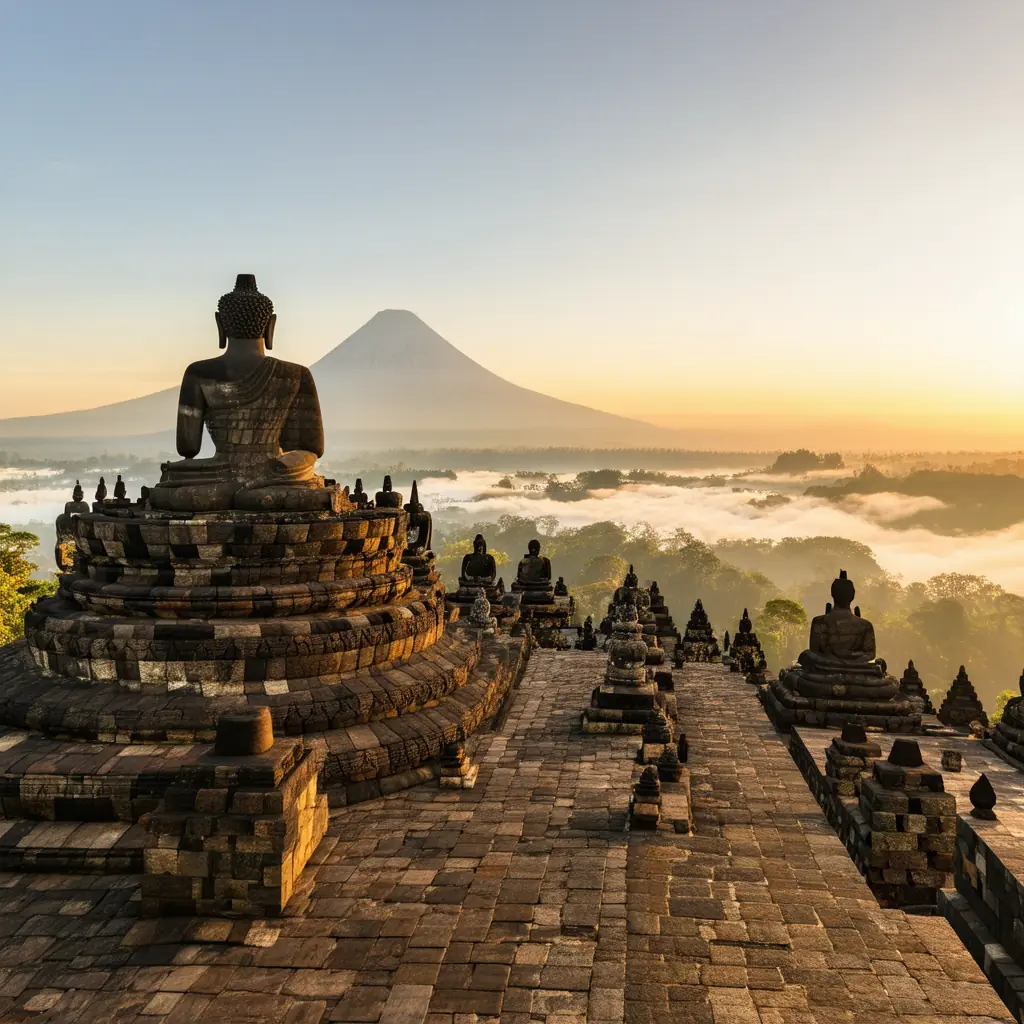
Borobudur is a ninth-century stepped pyramid built from around two million blocks of andesite, carrying five kilometres of narrative relief and 504 Buddha statues, and it is the largest Buddhist monument in the world. It is also under real pressure: decades of unrestricted climbing wore the stone steps visibly, and in 2023 the management introduced a capped, timed, guided system for the upper terraces. Turning up without understanding that system is the main reason visitors leave disappointed.
How access works
General admission gets you into the grounds and up to the base of the monument. Climbing to the upper terraces is a separate, capped ticket: you book a numbered time slot, wear supplied upanat sandals designed to protect the stone, and go up in a small group with a licensed guide. Daily numbers are limited and the early slots go first, so book online in advance rather than at the gate. Foreign-visitor pricing is substantially higher than domestic, and prices and quotas have been revised more than once — verify current rates before travelling.
The structure
Nine stacked platforms — six square, three circular — rise to a single large central stupa. The design is read as a three-dimensional diagram of the Buddhist cosmos: the hidden base representing the world of desire, the square galleries the world of form, and the plain circular terraces above the formless. There is no interior. The whole thing is a solid mass of stone fitted without mortar, built by the Sailendra dynasty in the ninth century, abandoned within about a hundred and fifty years, and covered by volcanic ash and forest until Raffles's survey in 1814.
Restoration and threats
Two great restorations shaped what you see. The Dutch engineer Theodoor van Erp led the first from 1907 to 1911. The second, a UNESCO-backed project from 1975 to 1982, dismantled and rebuilt the lower galleries entirely, cleaning and cataloguing over a million stones and installing a drainage system inside the hill to stop the structure sliding. Since then the threats have been ash from Merapi's eruptions — the 2010 fall required a major cleaning operation — along with acid rain, weathering, and the sheer volume of feet, which is what the 2023 access system addresses.
Practical detail
The site opens early and the first slots are the best: cooler, softer light on the stone, fewer people. There is no shade on the terraces and the andesite radiates heat by ten. Bring water, a hat and sunscreen. Modest dress is expected and a sarong is provided at the gate. Weekdays are materially quieter than weekends and school holidays, which are driven by domestic tourism rather than foreign visitors. Allow two to three hours if you intend to walk the relief galleries properly, which is the point of being here.
Visiting the Monument at a glance
| Built | 9th century, Sailendra dynasty; ~2 million andesite blocks |
|---|---|
| Structure | Nine platforms, 504 Buddha figures, no interior |
| Upper terraces | Timed, capped, guided slots in supplied sandals |
| Book | Online in advance — early slots sell out |
| Restorations | Van Erp 1907–11; UNESCO project 1975–82 |
| Allow | 2–3 hours to walk the galleries properly |