Non Nước Beach & Marble Village in Da Nang
A visual guide from the Da Nang travel guide — see all posters in Visual Guides.
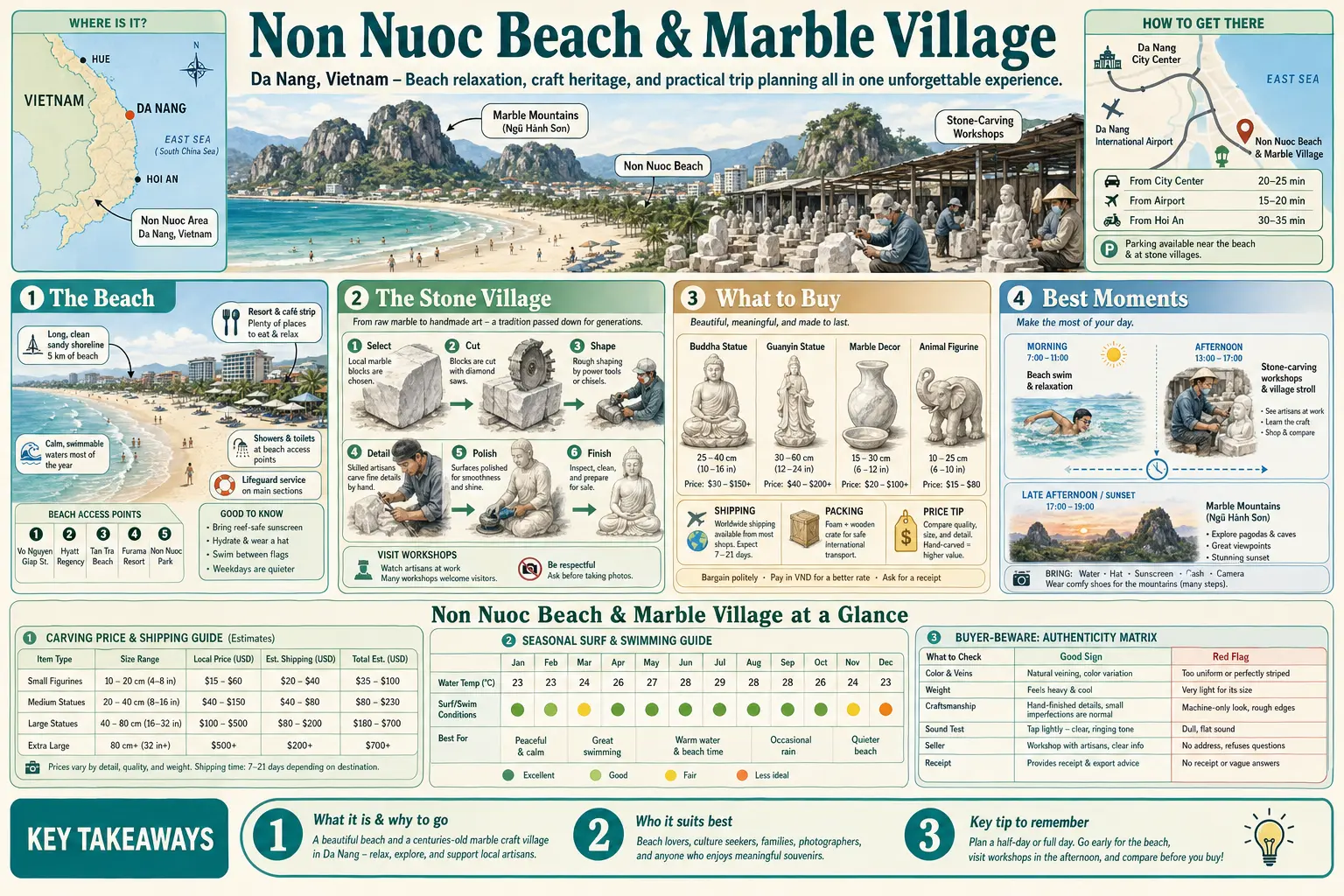
Non Nước is the southern end of Da Nang's beach strip, a wide pale arc under the stone stacks of the Marble Mountains, quieter than Mỹ Khê because the resorts sit back from the sand and the day-trippers stop short. Directly inland, at the foot of the mountains, is the stone-carving village that gives the beach its name and its reputation: hundreds of workshops, a permanent haze of marble dust, and the loudest souvenir shopping in Vietnam.
The Beach
The sand is wider here than at Mỹ Khê and the crowd is a fraction of it — resort guests, a few local families, vendors working the tideline. Same ocean, same rules: the water is at its best roughly March to August, and the same northeast swell that closes it in autumn is what brings the surfers back. There is public access between the resort frontages, though it is not always signed, and facilities thin out fast the further south you walk. Ngũ Hành Sơn is a five-minute ride inland, which makes a beach morning and a cave afternoon an easy pairing.
Inside the Carving Village
Workshops line the roads at the base of the mountains and most will let you watch. Blocks are cut down with diamond saws, roughed out with angle grinders and pneumatic chisels, then finished by hand — chisels, rasps, wet sanding through progressively finer grits, then polishing. The stone itself no longer comes from the mountains behind: quarrying Ngũ Hành Sơn was stopped to protect them, so marble is trucked in from Thanh Hóa and elsewhere, and some of the white and green stone is imported outright. That is normal, not a scam — but it does mean local marble is a sales line, not a fact.
Buying and Shipping
Buy small and buy dense. Mortars and pestles, coasters, bookends, chess sets, small animals and jewellery all travel in a bag and cost nothing to carry home. Be sceptical of anything sold as jade — dyed stone is common — and tap a piece before you believe it is stone at all, because resin castings exist. The life-size lions and standing figures are the trap: workshops will happily arrange sea freight, but crating, port fees and customs clearance regularly cost more than the carving did. Get the quote in writing, confirm door-to-door versus port-to-port, and expect weeks, not days.