Palaces and Royal Architecture in Hanoi
A visual guide from the Hanoi travel guide — see all posters in Visual Guides.
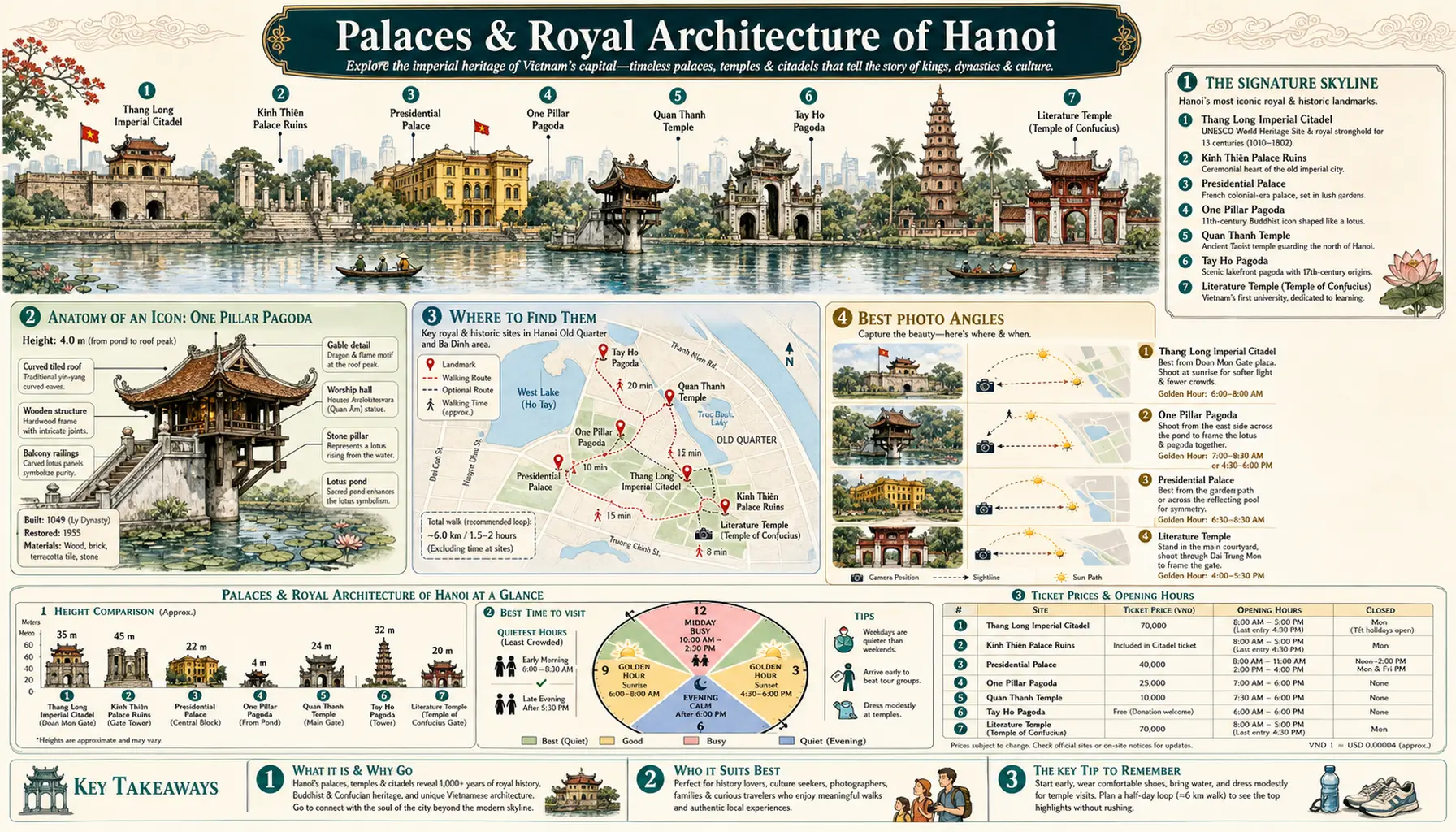
Hanoi wears a thousand years of power on its sleeve, but not the way you'd expect. Instead of gilded fairy-tale palaces, its royal legacy survives as excavated foundations, colonial-era mansions, and a walled citadel tucked between government buildings. It's a quieter, more layered kind of grandeur & a good excuse to pair a short historical detour with the genuinely modern city that has grown up around it.
The Imperial Citadel of Thang Long
The Imperial Citadel of Thang Long, a UNESCO World Heritage Site, marks where Vietnam's royal court governed for nearly a thousand years. Much of the original palace complex is gone, but excavated foundations, the Doan Mon gate, and the Kinh Thien terrace with its stone dragon staircases still convey the scale of the site. Archaeological pits display layered artifacts from successive dynasties, making it more of an open history lesson than a postcard palace & a worthwhile stop if you enjoy context before the modern city takes over.
French Colonial Grandeur
Hanoi's most photogenic "palace" architecture is arguably colonial, not royal. The mustard-yellow Presidential Palace, built for France's Indochina governor-general, is a striking Beaux-Arts landmark you view from its gardens rather than enter. Nearby, Ho Chi Minh chose to live and work in a simple stilt house instead & a deliberate contrast that's part of the site's story. The surrounding boulevard of colonial villas and government buildings gives a strong sense of turn-of-the-century European design transplanted into Southeast Asia.
Where Old Power Meets New Skylines
What makes Hanoi interesting today is the contrast: step outside the citadel walls and you're back in a fast, modern capital of glass towers, rooftop bars, and buzzing night markets. The Lotte Center and newer developments in districts like Tay Ho and My Dinh show off Hanoi's contemporary skyline ambitions, while sleek cafes and design-forward hotels now occupy restored colonial shells. Treat royal and colonial sites as a compact morning detour, then spend the rest of your day in the city's genuinely modern architecture, food scene, and lakeside views.
Practical Tips for Visiting
The citadel and Presidential Palace complex sit close together in central Hanoi, so both are easily combined into a single half-day visit on foot or by taxi. Mornings are cooler and less crowded, and modest dress is expected since parts of the grounds retain ceremonial significance. Photography is generally welcome outdoors but restricted inside some interiors. Afterward, the surrounding streets offer excellent coffee and modern dining, making it easy to pivot straight from history into Hanoi's contemporary urban rhythm.