Grand Bridges and Gateways in Hanoi
A visual guide from the Hanoi travel guide — see all posters in Visual Guides.
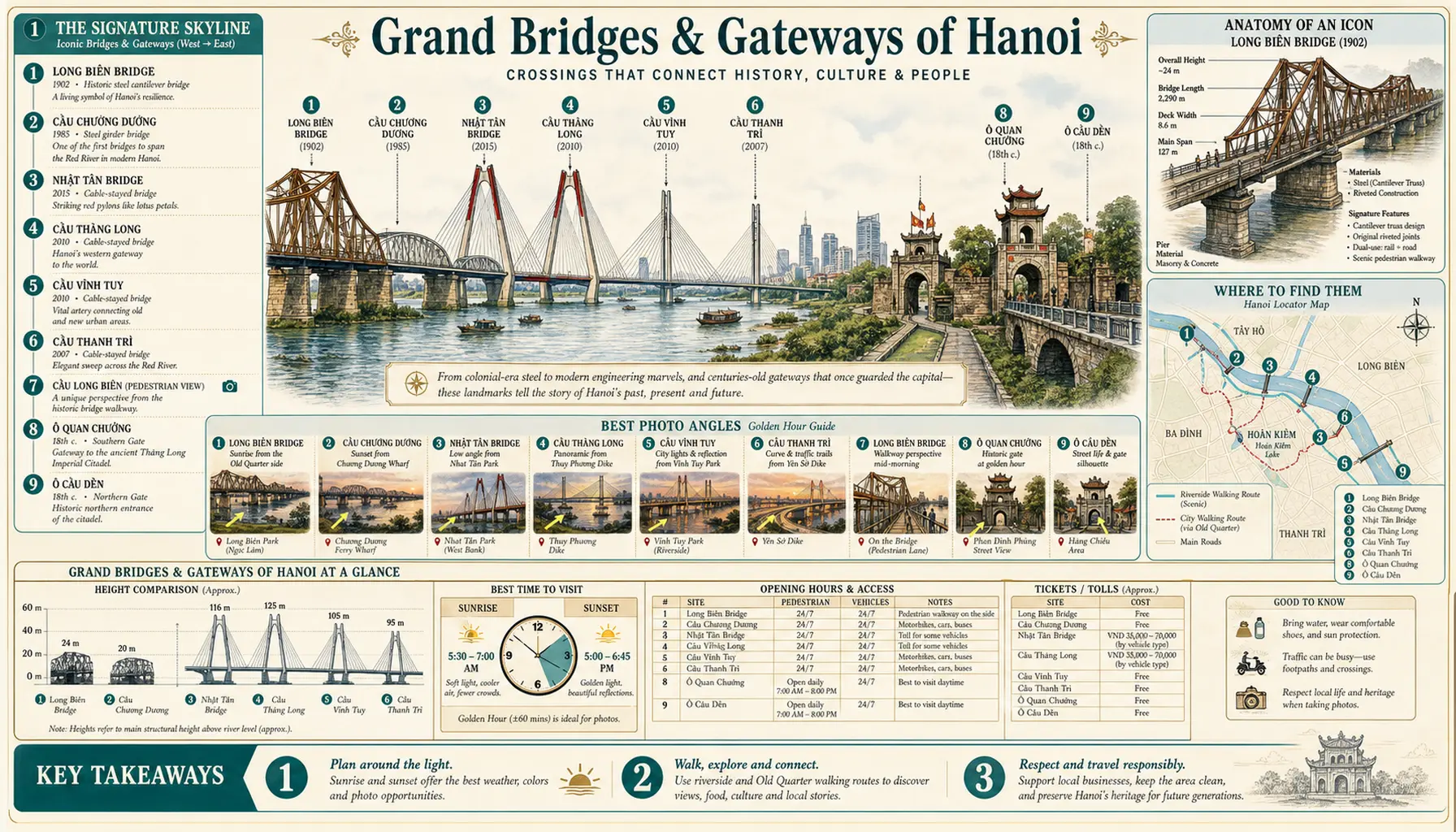
Hanoi is a city defined by its river crossings. The Red River loops around the capital in a wide, silt-brown arc, and the bridges spanning it tell the story of Hanoi's transformation & growth — from a rattling colonial-era truss bridge still carrying motorbikes and trains, to sleek modern spans that link the old center to glassy new districts and the airport beyond. Crossing them is one of the best ways to feel the city's scale and its restless, forward-leaning energy.
Long Bien Bridge
Built by the French in the early 1900s and once a wartime target, Long Bien Bridge is Hanoi's most iconic crossing — a riveted iron skeleton that still carries trains, motorbikes, and pedestrians over the Red River. Walking or cycling partway across at sunset, with the river's banana groves and sandbar farms below, is one of the city's most atmospheric free experiences. Its steady, unglamorous survival through a century of change makes it a quiet symbol of Hanoi's resilience rather than a museum piece.
Nhat Tan Bridge and the Road to the Airport
The graceful, cable-stayed Nhat Tan Bridge is Hanoi's most futuristic gateway, its towers and steel cables lit up at night as it carries traffic between the city center and Noi Bai International Airport. It is often the first and last thing visitors see of Hanoi, and its clean modern silhouette against the river sets the tone for a capital that is building fast. The drive across offers wide-open views of the Red River delta and the emerging skyline on its northern bank.
Thang Long and the City's Other Crossings
Beyond the two headline bridges, spans like Thang Long Bridge and Chuong Duong Bridge keep Hanoi's traffic — and its endless tide of motorbikes — flowing between the historic core and rapidly developing districts across the river. These workhorse crossings rarely make postcards, but riding over one at rush hour, surrounded by a river of scooters, is as authentic a Hanoi moment as any temple or lake.
Gateways Into the Old Quarter
Closer to the city's heart, Hanoi's real "gateways" are its street corners and roundabouts, where the tangled lanes of the Old Quarter open onto wide French-built boulevards and, increasingly, glass-fronted towers and rooftop bars. This layering of eras — colonial arcades, socialist-era blocks, and glossy new development — makes simply walking from the lakeside into the old streets feel like crossing between different centuries of the same restless city.