Civic Landmarks and Clock Towers in Siem Reap
A visual guide from the Siem Reap & Angkor Wat travel guide — see all posters in Visual Guides.
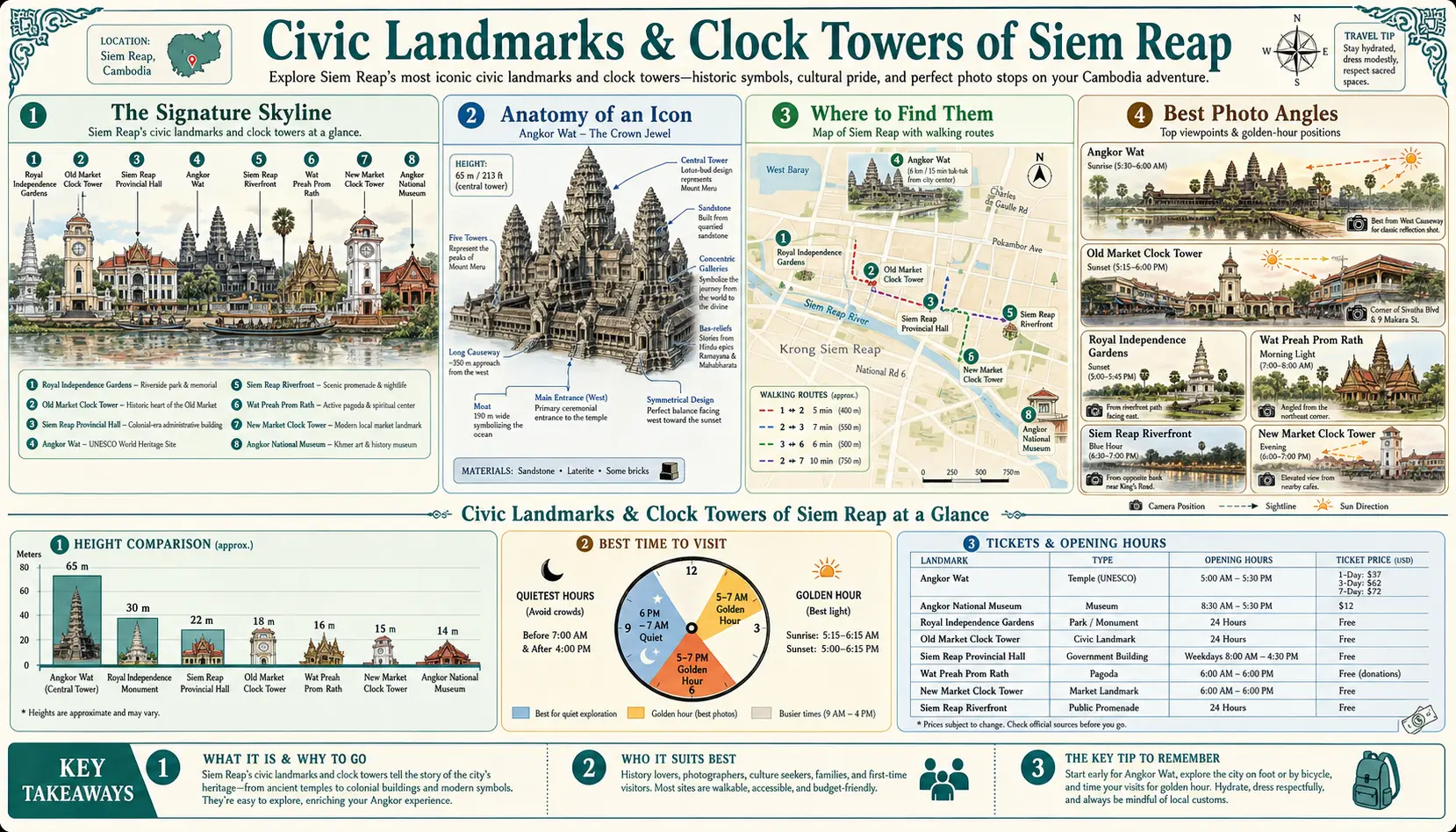
Siem Reap is best known for the ancient temples on its outskirts, but the town itself has quietly grown into a walkable, modern hub with its own civic character. Riverside promenades, landscaped roundabouts, and a compact grid of boulevards give the city a sense of order and progress that surprises first-time visitors expecting only ruins. This is a place where a fast-growing tourism economy has funded genuine civic upgrades & public spaces worth exploring on foot or by bicycle.
A River Runs Through the City Center
The Siem Reap River splits the town in two, and its banks have been developed into one of the city's most pleasant public spaces. A landscaped walkway follows the water past low bridges, string lights, and open-air cafés, linking the Old French Quarter to the busier commercial streets. In the early evening, locals and travelers alike stroll here to cool off, and it functions as the closest thing Siem Reap has to a central civic promenade — unhurried, green, and genuinely pleasant rather than purely functional infrastructure.
Roundabouts as Landmarks
Rather than a single town-square clock tower, Siem Reap orients itself around a series of large, decorated roundabouts that double as informal civic landmarks. These traffic circles anchor the main roads into town and are used constantly by locals for directions — "turn at the roundabout" is standard local shorthand. Landscaped with fountains and seasonal lighting, they reflect the city's rapid modernization, having been upgraded in step with Siem Reap's growth from a quiet gateway town into a major international tourism hub.
The Old French Quarter
Near the river sit blocks of colonial-era shophouses and civic buildings dating from the French colonial period, now repurposed as boutique hotels, restaurants, and galleries. Cream-colored facades and shuttered windows give this quarter a distinct architectural identity, separate from both the ancient temples and the newer commercial strips. It's a compact, walkable pocket of the city where preserved civic architecture blends comfortably with contemporary cafés and boutiques, making it one of the most photogenic and pedestrian-friendly corners of town.
A Rapidly Modernizing Skyline
Just beyond the historic core, Siem Reap's skyline is filling in with new hotels, an expanded international airport, and modern retail developments catering to the steady flow of visitors. Wide boulevards, organized signage, and public lighting projects signal a town investing in its everyday infrastructure, not just its tourism draw. For a city forever linked to Angkor's ancient past, the contemporary civic fabric — roads, bridges, riverside parks, and modern public buildings — tells the more surprising story of how quickly Siem Reap has modernized in recent decades.