Archaeological Treasures of Angkor
A visual guide from the Siem Reap & Angkor Wat travel guide — see all posters in Visual Guides.
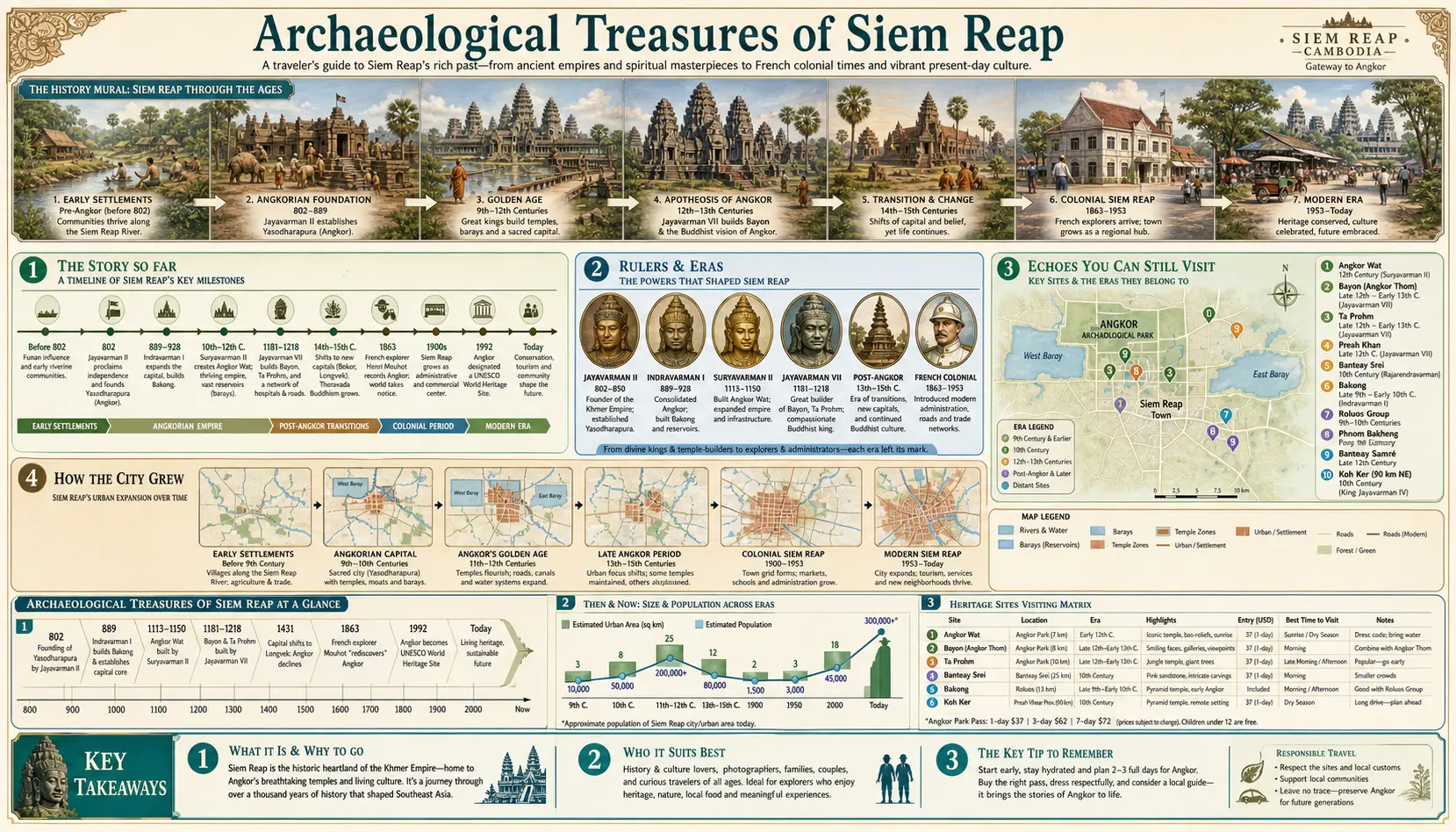
Siem Reap is the gateway to one of humanity's greatest feats of engineering and stone-carving: the Angkor archaeological park. Spread across hundreds of square kilometres of forest, its monuments range from the colossal Angkor Wat to intimate, filigree-carved shrines. Built by the Khmer Empire between the 9th and 15th centuries, then partly reclaimed by jungle, Angkor is a UNESCO World Heritage marvel best appreciated as a wonder of design, scale, and nature intertwined.
Angkor Wat & Bayon
Angkor Wat is the largest religious monument on earth, and its sheer scale is the point — a moated sandstone mountain whose five towers famously catch the sunrise. A few kilometres north, the walled city of Angkor Thom centres on the Bayon, its towers carved with more than 200 enormous, serene stone faces that seem to watch you from every angle. Together they anchor any visit and reward slow, early-morning exploration before the heat and crowds build.
Ta Prohm & the Jungle
For many travellers the most atmospheric ruin is Ta Prohm, deliberately left as explorers found it, with massive silk-cotton tree roots pouring over and through the stonework. It's the clearest picture of how nature and architecture have wrestled here for centuries, and it photographs like nowhere else. Go early or late to catch soft light in the courtyards, and take your time on the smaller paths where the tangle of root and carved stone is at its most dramatic.
Banteay Srei & the Fine Detail
Not every treasure is monumental. Banteay Srei, further out, is small but astonishing — carved from pink sandstone into some of the most delicate, deeply cut reliefs anywhere in Khmer art. Pairing a giant like Angkor Wat with this jewel-box of detail gives a fuller sense of the empire's range. Consider a multi-day pass and a knowledgeable guide; the distances are real, and the stories behind the stone turn a photogenic ruin into an unforgettable one.